

2015 Winter/Spring Archive
"Monterey Bay," Winter/Spring 2015
This archive preserves previously published materials that document stories, initiatives and community impact over time. Content reflects the context, priorities and perspectives at the time of publication.
Materials in this archive are provided for reference purposes only and may not reflect current programs, policies or organizational updates.
Explore the collection to gain insight into past work, evolving priorities and the broader impact of these efforts over time.
Contents
News Briefs
The Class of 3 Million is coming
When graduates cross the stage at commencement next May, they will join not only the Class of 2015, but also The Class of 3 Million – three million graduates of the California State University system.
It’s one of the largest alumni networks in the world.
To mark this milestone, 2015 graduates as well as alumni from all 23 CSU campuses are invited to “sign” The Class of 3 Million Yearbook. The online yearbook is a way for CSU alums to connect and build relationships with one another.
Everyone who signs the yearbook will be entered to win one of three $10,000 scholarships for a current or future student. All 2015 grads will receive Class of 3 Million silicone wristbands in time for commencement ceremonies.
Sign the yearbook at Classof3Million.calstate.edu.
Professor, grad student work to protect Big Sur River
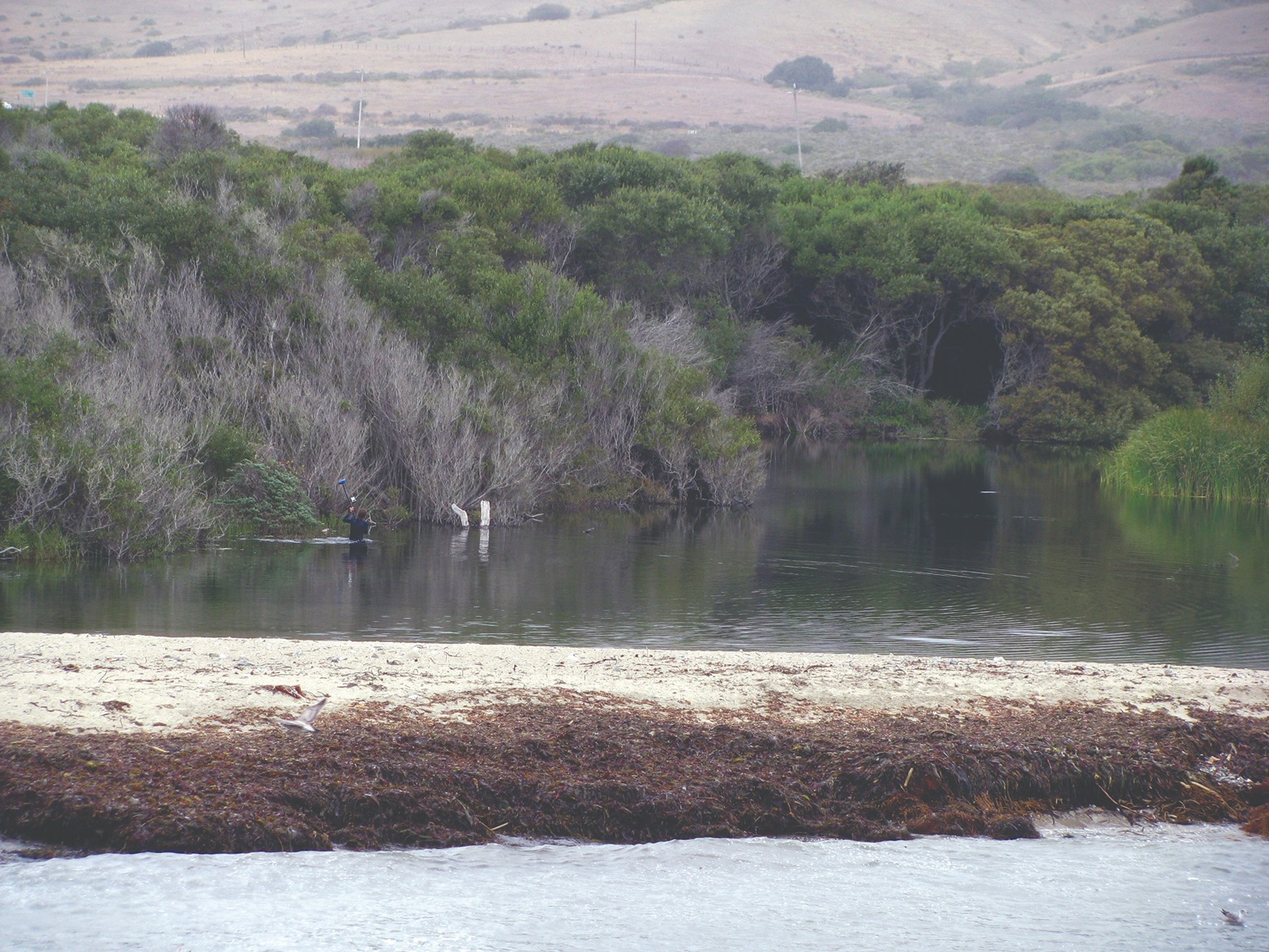
Cal State Monterey Bay Professor Doug Smith and graduate student Sam Phillips are collaborating with federal and state resource agencies to develop the Big Sur River Watershed Management Plan. The plan summarizes the environmental condition of the watershed and details the steps that residents and resource managers can take to sustain the local salmon population.
The Big Sur River and other ecologically critical streams and wetlands are constantly threatened by human activities that alter how water flows over and through the landscape. Urbanization and agricultural impacts are the leading cause of declining salmon populations along California’s Central Coast. While some impacts are inevitable, they can be markedly reduced or avoided through thoughtful and well-considered planning.
Resource managers can use the Big Sur management plan to apply for state and federal funding to make improvements that will help this important species thrive far into the future. Phillips used a wide range of cutting-edge tools in the project. The internship experience helped him land a position as a Fish Habitat Specialist with Eco Logical Research, Inc.
Study could yield changes in fishing behavior

With a $320,000 grant from the National Oceanic and Atmospheric Administration and help from several partners, Professor James Lindholm will study how the impact of traditional trawling on the seafloor may be reduced by using modified gear.
In traditional bottom trawling, large nets are dragged across the seafloor, altering fish habitats that occur there. Dr. Lindholm’s study will compare the impacts of traditional gear to newly modified gear that significantly reduces contact with the seafloor.
The project will start next summer off Half Moon Bay. “We hope the study will yield insights that result in changes in fishing behavior,” Dr. Lindholm said.The project is a collaborative effort among CSUMB, the Environmental Defense Fund, the Monterey Bay National Marine Sanctuary and fisherman Giovanni Pennisi.
Catch CSUMB on tv
In partnership with KCBA Fox 35, the university is producing a weekly television program, “Campus to Community.” It’s part of CSUMB’s commitment to serving as a catalyst for positive change – through education, outreach and public service.
The show highlights speakers and issues of interest to the Central Coast. Students, alumni, faculty and staff are involved in the production of the program. Some installments feature one speaker, others are a magazine format with short segments highlighting various programs and professors.
The hour-long show started in early October and airs every Sunday at 8 a.m.
KCBA can be found on channel 3 on Comcast and on channel 35.1 on the campus cable system.
10 More Reasons to be Thankful for Nurses
CSUMB first nursing class makes history
For one group of history-making Cal State Monterey Bay graduates, it’s not about the caps and gowns. It’s about the pin.
CSUMB’s first class of 10 nursing graduates participated in a pinning ceremony in late December. Commencement will follow in May.
“The ceremony is a tradition in nursing, where graduates receive a pin unique to that program,” said Dr. Marianne Hultgren, director of nursing at CSUMB. “It dates back to the days of Florence Nightingale, when a pin was a way to identify a nurse.”
Students in the program designed the pin, which can be worn throughout a nurse’s career.
The ceremony marked an important milestone not just for the students, but also for the university. A nursing program was discussed in CSUMB’s early days. Funded by a grant, planning started in 2008; the first students were admitted four years later.
“As a pioneer, I feel like I have helped lay the foundation for future nursing classes,” said Jennifer Riccobono. “The students in our graduating class have set the bar high.”
Riccobono wasn’t aware of the possibilities in the profession until she entered the program.
“Nursing is not just caring for the patient at the bedside. Nursing is caring for whole communities; nursing is using technology so that the patient information we collect can be used in a meaningful way. Nursing is working to create health care policies that will benefit generations to come,” she said.
CSUMB offers the only bachelor of science in nursing degree in the tri-county region. The program started in 2012 in collaboration with four regional community colleges. Students begin their education at one of the two-year schools, spend time in a “blended” learning environment, and then complete their studies at CSUMB. They receive an associate degree in nursing from their community college and a bachelor of science in nursing (BSN) from CSUMB.
In the summer of 2014, a second track was added that allows already-employed nurses with associate’s degrees to earn a BSN while continuing to work. Classes are offered on campus, online and at local hospitals to make it easier for working nurses.
“The one thing I know for sure about our graduating class is no matter what nursing position we fill in the community, we will put our patient’s needs first and strive to make positive changes in health care,” Riccobono said.
Learn more about the nursing program at csumb.edu/nursing
Expanding Tech Horizons
Programs prepare a diverse workforce
Daniel Diaz knows a good opportunity when he sees it. The 20-year-old sophomore from Salinas was interested in engineering, but when he learned of a computer science program that would allow him to graduate in three years, debt free, he signed up.
He’s aware of the lack of diversity in Silicon Valley, and thinks it needs to be addressed. “A limited workforce is, well, limited,” he said.
When Google released information on its workers last summer, it became the first tech company to do so. Apple, Facebook and Twitter followed suit.
The numbers were not a surprise. They indicated the tech sector is staffed by a workforce that is overwhelmingly male and white or Asian. In a blog post, Google pointed out part of the problem: the majority of computer science degrees are earned by white men.
Cal State Monterey Bay is trying to do something about that with two new initiatives aimed at graduating students from its bachelor’s degree programs in Computer Science and Information Technology (CSIT).
Diaz’s program, called CSIT-In-3, is a partnership with Hartnell College, a community college in Salinas. It started in the fall of 2013 with its first class, or cohort, of 32. Another 32 students started this fall.
Motivated by the success of students in the three-year program, a similar cohort-based effort was launched this year for students on a four-year track, called CSIT++. The first group of 30 students started in the fall.
Of the students participating in these programs, 73 percent are Latino, 40 percent are female, and a majority of them are the first in their families to attend college. In both programs, the students follow a pre-determined series of courses and commit to more than 10 hours per week of organized study and enrichment activities outside the classroom. During their second and third summers in the programs, students will complete paid internships.
The Matsui Foundation and a National Science Foundation grant provide substantial scholarship money, allowing many students to graduate without needing loans.
Sathya Narayanan, associate professor of computer science at CSUMB and co-director of these programs, is passionate about the issue of diversity in the high-tech workforce. He poses the question, “Can Silicon Valley continue to innovate without diversity?” It’s clear he thinks the answer is no.
“Silicon Valley has traditionally recruited from a handful of elite universities – universities that are on average over 80 percent white. When your workforce looks drastically different from your customer base, that’s going to impact your competitive edge,” he said.
“We really believe we have something important happening at our institutions, something that can move the needle in addressing the talent search and diversity challenges of Silicon Valley.”
He’s referring to the diversity of the students in the CSIT-In-3 and CSIT++ programs as well as the programs’ design. Both are intentional.
An infrastructure has been built to support the students every step of the way, including tutoring, workshops, field trips and guest speakers. The cohort design – where students who start the program together take all their classes, participate in extracurricular activities and graduate together – appeals to students.
“You can ask other students for help,” Diaz said. “I like the support. The structure allows me to focus since they take care of the details.”
Second-year student Maritza Abzun is glad she enrolled. She didn’t realize what she was undertaking – “there’s so much to learn,” she said. “They give you so many resources; they keep you on track,” she said. “The cohort part is great. You help each other.”
Both students were quick to mention the value of the Matsui scholarships. The $30,000 per student covers tuition and ensures they won’t have to work while trying to keep up with the rigorous classes.
Securing internships has been a challenge. Tech companies could increase their supply of diverse talent by hiring interns from schools – such as CSUMB – outside their traditional pipeline.
“Silicon Valley companies can’t change their workforce diversity unless they are wiling to change how they award internships,” Joe Welch, co-director of CSIT-In-3 said. “They’re probably not using a process that is inclusive.”
Diaz is undecided about what he’ll do after he graduates – maybe graduate school, maybe a job in Silicon Valley. He’ll have a better idea after he completes an internship.
Abzun plans to pursue the education aspect of computer science. “I love teaching,” she said. “I love that ‘ah ha’ moment when someone finally understands something.” She plans to teach in high school.
Both Narayanan and Welch are convinced that a cohort-based model can help to supply the computing talent needs of the U.S. economy. “We believe we are at the beginning of a model that can make a significant impact,” Narayanan said.
Learn more about the program at csumb.edu/csit.
Looking Back
Honoring the legacy of Fort Ord
Cal State Monterey Bay has turned 20 years old. The campus grew out of Fort Ord, a decommissioned Army base with a rich history going back to 1917. The base was a major location for basic training, reaching its heyday during the Vietnam War. More that 1.5 million men and women have served here.
As the university moves forward, the service of these men and women will always be remembered. Their legacy is a part of CSUMB’s identity. Today, you’ll still find pieces of Fort Ord’s military past across campus – in murals, in renovated buildings, and even in new buildings such as the Alumni & Visitors Center (the lobby ceiling is made of wood recycled from demolished Army barracks).
We are weaving our own story into theirs. This is still a place of transformation – and will be for years to come.
Check out the slideshow below for additional photos from Fort Ord's history.
Tear It Down
The next steps for CSUMB's future
Even while Cal State Monterey Bay is in a growth mode, people on campus are nearly as excited about buildings coming down as they are about the ones going up.
Abandoned military buildings – decaying reminders of the campus’s Fort Ord legacy – are being removed. While many of the former military buildings have been repurposed, others are unusable because of their age, condition, cost-prohibitive abatement issues, or non-compliance with current building codes and accessibility standards. Campus officials hope the blight removal can be completed in the near future.
“We believe (the cost of) all of our remaining demolition will be approximately $30 million,” said Katie Timmerman, senior construction/project manager for Campus Planning and Development. “What we have been discussing with the CSU Chancellor’s Offce is receiving that money in three phases, over three years.”
She said once the funding commitment is finalized, the university will take about six months to come up with step-by-step guidelines for the remaining demolition. Removing the “hammerhead” buildings – former barracks that stand in a line on the eastern side of campus – is the top priority.
The CSU-funded demolition of 14 buildings on campus last summer: 13 in the Dunes area on the northwest side of campus, and one portion of a hammerhead.
Companies bidding on the demolition face a number of challenges. First is abatement. When the buildings went up, asbestos insulation and lead paint were the norm. Now those hazardous materials require special handling and disposal.
It’s also difficult for bidders to estimate demolition costs for buildings constructed at different times to a variety of standards.
“Some are just quick-and-dirty construction, some are built like fortresses,” Timmerman said. “Going into a project, it is hard to know which is which.”
For example, the company that demolished the Dunes buildings this summer previously had done a similar demolition of two buildings on Divarty Street, Timmerman said. The company found, however, that the Dunes buildings had been constructed to a later code, with considerably larger footings that took twice as long to uproot.
Despite the challenges – or perhaps because of them – the university expects the project to attract a number of qualifed bidders.
Moving On Up
University Corporation supports increased levels of service for students & local community
Universities with long histories often also have large cash endowments. The income produced by that endowment can be used to meet a long list of university needs, from construction projects to student scholarships.
Cal State Monterey Bay doesn’t have a long history. Neither does it have a large cash endowment. What it does have, however, are 1,253 housing units located east of its main campus that were transferred to the new university as part of the conversion of Fort Ord.
Managed by the University Corporation, a nonproft 501(c)(3) public benefit corporation established in July 1994, those rental units produce income used for improvements and purchases benefitting the university.
“Money from the corporation is not the same as the General Fund taxpayer money the university is given through the State budget process. It is important for people to understand that,” said Kevin Saunders, CSUMB’s vice president for finance and administration and executive director of the University Corporation. “It (corporation revenue) is really to provide funding for programs that the state doesn’t support.”
The corporation’s role has drawn more attention in the past year as a result of two real estate purchases.
In March, the corporation purchased the former headquarters of the Monterey Herald in Ryan Ranch in Monterey for $5.7 million. The Herald’s owners had put the property on the market as they sought a smaller office space. Saunders brought the opportunity to the attention of President Eduardo Ochoa and other university leaders. The corporation Board of Directors, which is headed by President Ochoa and includes a faculty, staff, student and community representative, gave Saunders the go-ahead to negotiate the purchase, then approved the sale.
Saunders said the 62,500-square foot building was attractive because it provided much-needed space close to campus at a relatively low price. (While it is somewhat of an “apples to oranges” comparison, the Business and Information Technology (BIT) building, currently under construction, will have similar square footage at a cost of $43 million.)
He said enrollment growth and ongoing demolition of outdated military buildings, a few of which are still partially occupied, are adding to a space shortage on campus. This new space will provide some flexibility during the transitions, as the university moves programs and offices.
The Herald remained in its old headquarters through August. CSUMB took over occupancy in September and began to make repairs. Saunders said the university hopes to move programs into the building – perhaps marine science research, some administrative offces and space for professional development or outreach classes – early in 2015.
The corporation is also in negotiations to acquire the National Steinbeck Center. CSUMB has not made a final determination about how it will use the space, but the center will be the anchor for programs offered in Salinas.
The purchases are only the latest of the corporation’s investments in the university. Overall, the corporation has transferred more than $29 million to support university projects.
The corporation provided $6 million to help fund the Tanimura and Antle Family Memorial Library in 2008 and provided another $3 million to finish the third floor in 2011. It is currently paying debt service on bonds that funded construction of North Quad housing, campus wet labs, the renovations of all of the main campus residence halls and the Black Box Cabaret. Corporation funds also supported renovations of the Dining Commons, the Otter Express, and Monte’s Restaurant in the University Center.
The corporation also provided up-front construction funding for the Chapman Science Academic Center, which has since been paid back through fundraising. Corporation funds were used to build both the Library Cafe (commonly known on campus as Peet’s) as well as the Starbucks at the Student Center.
Corporation support includes the lease of the former Golden Gate University buildings for classroom space, an annual unrestricted contribution to the university, and fiscal and administrative oversight for the Foundation of CSUMB, the university’s philanthropic arm.
Saunders said by far the largest source of corporation revenue is the rental of the corporation-owned apartments to faculty, staff and the employees of educational partners. Rents on those apartments are set below the market rate, but they still generate considerable income because the corporation acquired them free and clear as part of the base transition. The corporation also manages a number of for-sale houses, where CSUMB employees can purchase a home, while the corporation retains a ground lease.
The corporation also oversees student housing, both on campus and in East Campus. The revenues from the student housing provide funding for the residential life offce and the intent is to have revenues and expenses break-even. The corporation’s 2014-15 budget projects a $2.43 million subsidy from the corporation for student housing.
The corporation also administers the financial functions – including payroll, accounting, and audits – for university grants and contracts, and oversees conferences and events, auxiliary services, including the university bookstore, KAZU public radio, and dining services.
“We generate net revenue, but it goes right back into supporting those programs and facilities,” Saunders said.
As the university enrollment continues to grow, the corporation expects to focus on student housing, which was in short supply at the beginning of this academic year. The Promontory, a 600-bed student housing complex, is currently being built by a private developer on the north side of campus. It is slated to open in fall 2015. Saunders said the corporation has an option to purchase that building when it is completed.
While the Promontory will provide immediate relief to the housing crunch on campus, it will not be sufficient for long at current rates of enrollment growth. So additional student housing will likely be needed.
“State general fund money cannot be used for student housing. So no taxpayer money will be used for that. It is all coming from the corporation,” Saunders said.
Through a New Lens
Travel down Inter-Garrison road on the CSUMB campus and it’s impossible to miss the explosion of color and vibrant imagery. Take a look. Study the layered composition. Notice the easily perceived and hidden elements that complement each other. It tells a story.
Students have completed much of the work on the mural along Inter-Garrison Road and Fifth Avenue, across from the Visual and Public Art (VPA) complex. The original Signs and Symbols mural that graced the wall for years was removed in January of 2014 to abate lead in the paint. During the spring 2014 semester, Professor Johanna Poethig’s painting and mural class, along with alumni muralists and faculty members, designed a new mural to replace it. Poethig’s students, along with students in Juan Luna-Avin’s painting and mural class, have worked steadily since to bring the project to life.
According to the VPA students who worked on the project, the centerpiece of the new mural is the compass. The compass symbolizes directions in life, and overlaps with an image of the globe, representing the world we all share, and situating CSUMB in the global arena. The lenses at each side of the compass magnify the values on which CSUMB is founded, acknowledging the past and looking forward. The currents that radiate out from the center across both sides of the mural are expansive as they illustrate the rippling effect we have on one another.
On the left is a reflection of the original Fort Ord military symbol that was the centerpiece of the wall. From there, the compass and lens are symbols of sports, hemispheres, humanities and a color wheel. The sun shines on Monterey coastal cypress trees. The trees reach out over a circuitry of technology and ancient iconographies.
On the right, the lens is a camera, a telescope or beacon and through both lenses light shines through toward the sky of unlimited possibility. The mural then transitions into a kaleidoscope of natural flower images. The symbol of the acorn represents the natural and historic landscape. The musical measure resonates across culture and turns into kelp flowing through the currents incorporating the natural habitat and marine sanctuary of Monterey Bay.
According to Poethig, the updated mural reflects on the vision of the university and draws upon the old design. “You don’t want to forget your history, but you also want to look toward the future,” she said.
Benefits of Brotherhood
How Nu Alpha Kappa helped Tony Garcia become a campus and community leader
As a freshman, Tony Garcia came to campus for class, then went home or went to work. He wasn’t sure if he should be in college or if he should be working to help support his family. Garcia, his parents, and four sisters had immigrated from Mexico only a few years earlier, when Tony was 14. Both his parents worked in the fields and money was tight.
But his mom had insisted on college. Tony was a good student, even if his ESL courses were challenging. With the help of a CSUMB College Assistance Migrant Program (CAMP) coordinator, he applied for college and financial aid, and chose CSUMB because it was close to home. He also got a cashier’s job at Target in Marina.
Things started to change after he attended the El Grito dance sponsored by the Nu Alpha Kappa fraternity. “I didn’t know anything about the Greek system, but I liked how they treated each other – the brotherhood, friendship and support,” he said.
Garcia decided to pledge with the fraternity. From there, he began to get more involved on campus. “I got to know people, started going to the library and attending Otter Student Union events,” he said. “Plus I went to workshops and stuff through CAMP and the Educational Opportunity Program.”
By sophomore year, he felt comfortable moving onto campus in order to get the whole college experience. “My (fraternity) brothers provide a lot of support with classes, personal problems. They’re like a second family.”
Nu Alpha Kappa, a Latino-based fraternity started at Cal Poly San Luis Obispo in 1988, welcomes members from all cultures and ethnicities. The CSUMB chapter has had 54 members since it was recognized on campus in 2004; 12 students are currently active with the chapter. They focus on academics, brotherhood and culture. Members must maintain a 3.0 GPA, and the group organizes two community events every semester.
The brothers have focused on early outreach events designed to expose children and their parents to the idea of college. They’ve brought elementary school students to the CSUMB campus for tours and they host a kids’ carnival every April. “We promote higher education, get the kids onto the campus and tell them about university life,” Garcia said.
“We always want to help the community by doing service, but last year my brothers and I wanted to do something more,” said Garcia, who, by junior year, had become the fraternity’s vice president. “We wanted to help incoming freshmen who are struggling, whose parents don’t have the funds. So I started investigating how to create a scholarship.”
For its 10th anniversary, the group held a dance and banquet at La Hacienda Restaurant in Salinas, and raised enough money to offer two $500 scholarships – thanks in large part to a significant gift from David Hernandez, Class of 2012. “We actually raised more than our goal, and hope to create four or five scholarships in the future,” Garcia said.
Garcia will graduate in May with a degree in Collaborative Health and Human Services. He’s still working 30 hours per week at Target, where he has moved up the ranks to guest services and shift manager. Before he graduates, he had to complete an internship with Alcance, a nonprofit organization that provides mentoring and job training to at-risk youth in Watsonville. For his senior capstone project, he helped the organization launch a social media recruitment campaign.
Even in this, his fraternity involvement has helped him. “I got this internship because a brother from another chapter referred me,” he said.
After graduation, Garcia thinks he’ll pursue a graduate degree in criminology and criminal justice at UC Santa Barbara. “I’d like to be a probation offcer who works with youth.”
Going Big for Social Justice
Sophomore Mia Elliott takes the helm of campus NAACP chapter
When Mia Elliott turned 18, registering to vote didn’t occur to her. “It was 2013, not a big election year, so I didn’t even think about it,” she said.
Through her involvement with the CSUMB chapter of the NAACP, she came to realize how important it is for college students to vote. She’s now the chapter president, and sharing that insight with her fellow students is one of her top priorities.
“I want to educate the uneducated. We need to learn and engage,” she said.
Elliott hopes to form a broader coalition of diverse student groups to help with a campus voter registration campaign. She plans to bring them together around shared goals, so that “people can realize social and cultural issues that go on in other communities, and what we can do about it to make an equal world for everyone.”
Another priority for Elliott is to diversify the membership of the NAACP chapter on campus. “I want people to know this group is for people of all colors and our allies,” she said. “Men and women. All kinds of different people working together to fight for equality. Everyone is welcome and encouraged to join the NAACP.”
From there, she wants to empower students to have a stronger voice on campus. “Change is a good thing, though sometimes people forget that. But if we aren’t changing and evolving, what’s going on?”
Heading these initiatives is a big commitment, but the sophomore from Sacramento feels this work is what she’s meant to do. “When I realized how important social justice was to me, it was either go big or go home.”
Elliott’s family has long supported and encouraged her. “I was always told, ‘Mia, you’re a leader.’ That shaped my life and the decisions I make. How I focus,” she said. She doesn’t feel like those expectations are a pressure, but rather something that keeps her motivated and striving. She’s a first-generation college student, and her success does mean a lot to her family. “Every day, my mom calls me and tells me she’s proud of me.”
At first, leaving her mother and grandmother to come to CSUMB was a challenge. “I wasn’t open to change,” she said with a laugh. “I didn’t realize how much I relied on my family. I felt attached to my old friends and family.” She even considered transferring to Sacramento State to be closer to home.
“But then something happened. I opened up, started to get more involved and that changed my school experience.”
Part of that evolution may have resulted from an internship at the Otter Cross Cultural Center and her growing involvement with the NAACP and Black Students United student groups. She credits OC3 coordinator rita zhang and Black Students United adviser Asya Guillory with helping her make the transition. “They both make me think. I’m grateful to have such great people come into my life in a short amount of time.”
“Now I feel like CSUMB is my second home. Deciding to come to CSUMB was the best decision I have made for myself. And I couldn’t imagine going anywhere else,” she said. “In my short time here I have learned so much about myself and who I want to be. And I honestly feel I wouldn’t have learned these things if I went somewhere else.”
After graduation, Elliott wants to earn a teaching credential, go to graduate school at UC Berkeley and join the Peace Corps. Eventually, she hopes to do social work with children.
“My biggest life goal is to make an impact on this world,” she said. “And do something life-changing for other people.”
Shared Values
New provost finds a good fit at CSUMB
In leadership training programs for higher education, speakers stress the importance of finding an institution whose values closely match your own, Bonnie Irwin said.
Cal State Monterey Bay’s new provost believes she has found just such a place.
“The particular things this institution does well were big attractions for me,” said Irwin, who took over as the university’s chief academic officer in July. “Service learning, that is important to me. The fact that we have an Office of Undergraduate Research, the vision that the president has for community engagement, all of those factors convinced me that this could be a good match.”
Irwin came to CSUMB from Eastern Illinois University, where she was dean of Arts and Humanities. She also was a full professor of English and previously had served as dean of the Honors College.
She said she first started thinking of becoming a provost while serving as Honors College dean.“You are dealing with admissions, you are dealing with alumni relations, with student affairs,” Irwin said. “You have the opportunity to work with all the different deans and all the different departments across campus. And I found I really enjoyed having that 30,000-foot view.”
The move from the Midwest to California is something of a homecoming for Irwin. She spent her early childhood in Chicago, where her father was an auditor for United Airlines.
The family moved to the Bay Area when Irwin was 12 and her father was transferred to San Francisco.
She attended Los Gatos High, and earned her bachelor’s, master’s and doctoral degrees in comparative literature at the University of California, Berkeley.
She taught at a New Jersey community college and Iowa State University before moving to EIU in 1994.
Over the years, she said she has become even more convinced of the transformative power of master’s degree-granting comprehensive universities such as EIU and CSUMB.
“You see so much growth in the students when you work in an institution like this one,” Irwin said.“Many first-generation students don’t really have an academic support system in place. It is not that they don’t come from strong families, but they don’t have the same experience in navigating the world of higher education.
“It is exciting to see those students go to college and succeed. Education just opens so many doors.”
Empowering Students
Sexual assault on college campuses has been making headlines across the country, with dozens of institutions under fire for their handling of rape allegations. We asked CSUMB Deputy Title IX Coordinator Anna Bartkowski to shed some light on this complex topic.
Q: Why is sexual assault on campus suddenly front-page news?
A: Decades of prevention efforts and awareness campaigns have resulted in decreased rates of sexual assault in most areas of the country except one – campuses of higher education. We haven’t moved the dial on rates of sexual violence on campuses in four decades. Approximately 20 percent of female students and 6 percent of male students experience some form of sexual assault during their college years; most don’t report the incident – either to police or to the university.
In 2011, the federal government became more involved. Federal and state legislatures, government agencies, courts, media and student groups have been criticizing the way in which colleges have handled reported cases of sexual assault. They are calling for greater enforcement, accountability and transparency from universities.
Universities have long used the campus judicial process and disciplinary procedures against students who violate the Code of Conduct’s rule against sexual misconduct. However, this approach fails to recognize that sexual assault and harassment on campus often stem from a culture of gender violence. Sexual assault is, at its heart, a civil rights issue properly governed by Title IX.
Q: What is Title IX?
A: Title IX is federal law that makes sexual discrimination in educational settings unlawful. For more than 40 years, Title IX has been used to ensure gender equity in athletics. The resulting social, psychological and physical benefits have been well-documented and profound.
When we talk about Title IX today, however, we need to expand the conversation to include any acts of discrimination, harassment or retaliation on the basis of sex. Rape and sexual assault, relationship violence and stalking are all forms of sexual harassment that create a hostile environment and trigger a duty for the university to respond.
Q: What is CSUMB doing to prevent and address sexual assault?
A: Following the lead of the CSU system, CSUMB has adopted strong policies against sex discrimination with grievance procedures allowing timely and equitable resolution of complaints, including steps to end any discriminatory activity, eliminate hostile environments, remedy the effects of such behavior, and prevent it from reoccurring.
CSUMB has established an administrative Title IX Advisory Board and a campus-wide task force to host events, inform and educate the campus community, encourage discussion and raise awareness about the issues of sexual assault and harassment. In the spring, in addition to bystander intervention training for students, we will be hosting CSUMB Rising – an event to empower people to end relationship violence.
Back Where They Belong
Former Otter competitors are now CSUMB coaches and leaders
Thomas Wolfe’s George Webber may not have been able to go home again, but there’s no place like their CSUMB home for Otter alumni. Case in point: CSUMB grads Darcy Lake Milligan (HCOM, ’12) and Ashlee Trotter–Barba (HCOM, ’10), who returned to CSUMB this fall to accept positions as coaches with the Otter golf and softball teams, respectively.
Milligan, one of the top women’s golfers in CSUMB history, was an All–American as a senior in 2011. She won the individual title at the 2010 NCAA West Super Regional, leading the Otters to their best ever finish at No. 7 nationally that season. Since graduating from CSUMB, she has worked as an assistant golf professional at Bayonet Black Horse Golf Course. In 2012, she married former Otter golf NCAA Champion DJ Milligan (BUS, ’11).
Trotter-Barba, meanwhile, was the first “star” position player for the Otters as a member of the first–ever Otter softball team in 2006. By the time she graduated, she had led the Otters to a pair of NCAA tournament appearances. Her name still peppers the CSUMB record book five seasons after her graduation. She had been the head varsity softball coach at North Salinas High before rejoining the Otters.
We sat down with the two newest members of the Otter coaching staff to learn what they’ve been up to and what brought them back home to CSUMB…
Catch us up on what you’ve been up to since graduating from CSUMB.
DARCY MILLIGAN: I started working part-time at Bayonet Black Horse Golf Course while I was still in college, and was able to obtain a full-time position there as an assistant golf professional right before graduation. I think my role as a CSUMB golfer had a lot to do with that. It has been a wonderful experience.
ASHLEE TROTTER-BARBA: Since graduation, I have gotten married to my high school sweetheart and continue to live in Salinas. I have been coaching high school. I love coaching here and I am so happy to be a part of the Otter family.
What influenced your decision to stay in the Monterey Bay area after graduating?
MILLIGAN: I absolutely fell in love with the Monterey Bay area during college (especially the weather, the beach, and the gorgeous scenery!) and I was hoping for a job opportunity that would allow me to stay here. Being that this is an outstanding location for anyone in the golf industry, it made sense for me to stay here, and I love every minute of it!
TROTTER-BARBA: Staying close to home was an easy decision for me. I am very close to my family and having the opportunity to start a program and play competitive college softball while being home was a dream come true. There was not one home game that my family missed throughout my career.
Did you both stay in close contact with the school after leaving CSUMB?
MILLIGAN: Since the teams still practice at Bayonet Black Horse, I’ve been able to keep in touch with our current golfers and follow their progress. Every once in a while I drive by campus and see new improvements, such as new buildings, new paint and new coffee shops. It’s been great to see all the progress that CSUMB has made the last few years.
TROTTER-BARBA: Since I was born and raised in the area and continue to live in the area, it’s been easy to stay connected to the school. The place where I feel most connected is on the softball field.
Was working in sports part of the plan coming into college or did the opportunities you had at CSUMB influence those decisions?
MILLIGAN: My plan changed a few times from the time I started freshman year. I finally settled on the human communication major with a business minor because I saw the various career options I had with those skill sets. I always had a passion for golf, but didn’t fully realize that I could incorporate golf into a career until I began working at Bayonet Black Horse. My experience as a college golfer at CSUMB had a lot to do with this realization as well.
TROTTER-BARBA: My degree in human communication made me realize how important it was to have great teachers and coaches. I found myself wanting to get back into the game and coaching was what I wanted to do. My degree has helped me with coaching and with the ability to understand and interact with my student–athletes.
The Doctor is In
Success is measured by the work that you do and the self-reliance you possess. Not from test scores.
That CSUMB philosophy proved to be invaluable according to Carrie Lara (SBS, '04), who carried that through graduate school, her doctorate program and into a successful career as a clinical psychologist with the Monterey County Children’s Behavioral Health Department.
“I love being able to work with individuals from all walks of life, studying the human mind, personality and behavior, and using that knowledge to help people,” she said.
CSUMB practiced outcomes-based learning, providing a very broad educational experience said Lara. Instead of weekly tests, the emphasis is on knowledge accumulated through a semester to produce a paper or project.It’s excellent preparation for the professional world
She credits professor Armando Arias for being a tremendous influence on her career. Arias saw Lara’s ability to choose her own path and for creativity, pushing her to take initiative. He was quintessential in finding Lara’s potential and helping her become more organized and focused.
As for a fellow student that played a formative role, that would be none other than Lara’s husband, Roger Lara (CHHS '06). They met at CSUMB during their freshmen year in Spanish class, reconnecting a year later in the dorms. He has been a strong supporter through the years and they now have a daughter together. “I am truly blessed to have Roger in my life,” she said.
Lara has many years ahead in her journey, both professionally and personally. CSUMB gave her the start. “I love that my profession is one that entails continuous learning. I get to be a perpetual student of life.”