

2018 Spring/Summer Archive
"Monterey Bay," Spring/Summer 2018
This archive preserves previously published materials that document stories, initiatives and community impact over time. Content reflects the context, priorities and perspectives at the time of publication.
Materials in this archive are provided for reference purposes only and may not reflect current programs, policies or organizational updates.
Explore the collection to gain insight into past work, evolving priorities and the broader impact of these efforts over time.
Contents
Toward a Brighter Future
When Eduardo M. Ochoa came to Cal State Monterey Bay as its president in mid-2012, he looked beyond the boundaries of his new campus to assess the challenges ahead.
“What I found when I came to CSUMB was that we had a remarkably diverse student body for a residential campus that in fact matched the ethnic composition of our service area,” Ochoa told the Chronicle of Higher Education in an interview conducted earlier this year. “But on the other hand our county … had an education level that was far below the state average.”
“Too many underserved communities were not succeeding in getting their young people through to high school graduation and being college ready,” he said.
“So we felt, if we were going to advance our access mission beyond where we were, we needed to reach down into earlier stages of the educational pipeline and partner with our K-12 colleagues.”
During his two-year tenure in Washington, D.C., as assistant secretary for postsecondary education, Ochoa had learned about the successes of Strive Networks – community-based collaborative initiatives whose goal is to improve outcomes at every step of the so-called cradle-to career pipeline.
I believe we are all here because we want every child in Monterey County to have access to an excellent education— Margaret D’Arrigo
Now, the local version of that initiative – called Bright Futures – is producing tangible results in Monterey County.
Its mission is to ensure that every child is prepared for school, succeeds inside and outside of school, completes a post-high school credential and enters a promising career.
Highlighting bright spots
In January, local partners in Bright Futures held a forum at CSUMB @ Salinas City Center to highlight educational success stories from around the county. The event brought together representatives of education, government, business and non-profit groups, all of whom are playing a part in the Bright Futures collaboration.
“I believe we are all here because we want every child in Monterey County to have access to an excellent education,” said Margaret D’Arrigo, vice president of community development for Taylor Farms, in opening the session.
The event highlighted bright spots, measures by which area schools were showing significant ongoing progress on a number of education measures. Participants were encouraged to look at displays which highlighted initiatives that were producing results at specific schools.
“We spend a lot of time focusing on the achievement gaps that exist. But we also need to take the opportunity to celebrate the accomplishment that are being made,” said Romero Jalomo, vice president of student affairs at Hartnell College, which has been an active partner in Bright Futures.
Accessible narrative of graphic
How many achieve? Estimated forecast: Cradle to career pipeline for kindergarten class of 2014.
- 7,000 will enter kindergarten
- 6,000 will start 12th grade
- 4,400 will graduate high school
- 3,000 will enter post-high school
- 1,500 will complete a program
2 out of 3 jobs in the United States will require a post-high school credential by 2020, but only 2 out of 7 Monterey County children will be career ready without a change of course.
We see a bright future for all young people. In 2015 only 20% of all youth will earn a post-high school credential; we want to improve that to 60% by 2025. That would triple the number of youth who complete a post-high school credential by 2025 and promote career readiness for all youth.
One cradle to career cycle is 22+ years. Improvements will compound over time and beyond.
All kids can learn
Cynthia Nelson Holmsky, director of Bright Futures, explained that her team, led by Michael Applegate, has built a “bright spots finder,” a computer program to analyze all public data about each grade level, classroom and subject countywide. The program looked for measures on which specific grades at each school were exceeding county and state averages for their peer group and had shown steady improvement of 10 percentage points or more over a three- year period.
“We were saying to ourselves, what if we only get two (bright spots) in the whole county? So when it returned more than 500 bright spots, we were thrilled. It was a big moment,” said Holmsky, who has directed the Bright Futures effort since it began in 2014.

What made the findings even more encouraging was that more than half of the bright spots came from schools that fell in the lowest economic quartile.
“There is the belief that you can’t break above these very low levels of performance (in low-income districts),” Holmsky said. “This completely changed that narrative because some of the bright spots are outpacing the state of California by 40 percent, with those very same poor kids. So we were very excited to use the data to challenge that set of assumptions and hopefully we can change the narrative to the idea that all kids can learn, that all kids respond to high expectations.”
Successes in Alisal
Among the districts whose accomplishments were highlighted at the event was the Alisal Union School District, located in East Salinas.
In Alisal Community School, where 96 percent of the students are classified as economically disadvantaged, former English language learners are now outperforming the state average for all students in English/Literacy by 34 percentage points and scores have increased by 32 percentage points over three years. The same students are outperforming state averages in math by 11 percentage points and have increased scores by 17 percentage points over three years.
Data is in every conversation we have and in every meeting we host.— Cynthia Holmsky
The event highlighted the three pillars of Bright Futures. First is the use of data, not anecdotes, to determine what works in the classroom. Second is the sharing of information about classroom successes to encourage collaboration and change. And, third is reinforcing the message that, to be truly effective, educational changes must impact students from all income levels and ethnic groups.
“It’s the power of collaboration. That is really the spirit of Bright Futures,” Holmsky said. “We don’t add a lot of resources. Rather, we engage existing resources in new and innovative ways.
“Many organizations are working on improvement, but are doing it in isolation. We’re just saying ‘Hey, let’s share the same goals, share resources so we can achieve more improvement together. By connecting those dots, a lot of change is happening.’”
Collective impact strategies
Bright Futures, and other similar efforts nationwide, embody what is called a collective impact strategy. A 2011 article by John Kania and Mark Kramer on collective impact in the Stanford Social Innovation Review cited the example of a Strive Network in Cincinnati, which brought together community leaders behind a common goal.
“These leaders realized that fixing one point on the educational continuum – such as better after-school programs – wouldn’t make much difference unless all parts of the continuum improved at the same time. No single organization, however innovative or powerful, could accomplish this alone. Instead, their ambitious mission became to coordinate improvements at every stage of a young person’s life, from ‘cradle to career.’
“Strive didn’t try to create a new educational program or attempt to convince donors to spend more money. Instead, through a carefully structured process, Strive focused the entire educational community on a single set of goals, measured in the same way.”
Bringing people together
Tim Vanoli was engaged with Bright Futures in its early days when he was superintendent of the Salinas Union High School District, and is now working with the initiative as superintendent of Soledad Unified School District.
“I think it is a terrific effort. It brings people together to share best practices and learn from what each other is doing,” Vanoli said. “It is very comprehensive. It is closely aligned with most of the educational initiatives that we are all really focusing on,” pointing in particular to college and career readiness measures.
California's new education accountability system includes the California School Dashboard, designed to allow the public to monitor school performance. One of its measures is college and career readiness, which is also a key factor for Bright Futures.
The big goal
An estimated two-thirds of all jobs will require a post secondary credential by the year 2020. The big goal of Bright Futures is, by 2026, to raise the percentage of Monterey County students who earn some type of post-secondary credential – an associate’s, bachelor’s or higher level degree or certificate – from the current estimate of 20 percent to 60 percent.
We engage existing resources in new and innovative ways.— Cynthia Holmsky
“With their new standards, the state of California has reconciled the fact that to graduate high schoolers without the (educational) rigor to go with it, is just not enough. Students need to be career-ready,” Holmsky said. “Technology is now part of every industry. Career technical education is no longer woodshop. It is high-impact, high- tech, so that needs rigor in high school, too. “
As the largest Monterey County employer, the agriculture industry has a growing need for more technically proficient employees.
“We really look at this (Bright Futures) as a way we are helping to build our future workforce,” said D’Arrigo of Taylor Farms. “We are generating a lot of data, and having people who can analyze that data and keep up with the technology is very important to us.”
Are they prepared?
The California Department of Education considers high school graduates "prepared" when they have earned a diploma and achieved at least one additional criteria, which include meeting standards in English language arts and mathematics, earning a passing score on two Advanced Placement or International Baccalaureate exams or meeting the course requirements for college admissions, among others.
To reach its big goal, Bright Futures has worked with education, business and community leaders to develop its own list of specific measures at all stages of the education- to-career pipeline to monitor and, they hope, continue to improve.
“Data is in every conversation we have and in every meeting we host,” Holmsky said.
The factors include access to affordable child care, measures of kindergarten readiness and language, literacy and critical thinking skills at key grade levels. The initiative is also tracking the percentages of high school students who fill out financial aid forms and complete core classes necessary to attend college, as well as the numbers who earn a post-high school credential and enter a promising career.
The plan is to monitor key pieces of data connected to each measure, as the initiative advances on its goal.
That, too, can pose a challenge. Monterey County includes 24 different school districts. Hartnell’s Jalomo points out those districts “don’t always speak the same language; they don’t have the same systems for reporting data.”
At the same time, Jalomo said the partners – from all sectors – who have joined the effort are working hard to make a difference.
“I think that Bright Futures has been perceived in a very positive way by the community. A lot of different people are coming to the table in a very authentic way to share their good ideas,” Jalomo said.
Supporting Educational Dreams
When Ernesto Verduzco came to Cal State Monterey Bay as a freshman in fall 2016, a peer mentor helped him adjust to his new, and challenging, educational environment.
“I really liked the bond I had with my peer mentor. He showed me how to do assignments I didn’t understand, how to draft emails, how to interact with professors when I needed help. All that information that as a freshman you may not understand, he helped me understand it better,” Verduzco said.
Verduzco, a collaborative health and human services major from Salinas, came to campus as part of the College Assistance Migrant Program (CAMP), one of several support programs that are helping students who are first-generation, low-income, migrant, disabled and foster youths.
And now Verduzco has become a peer mentor.
That (relationship with his mentor) is one of the reasons I was interested in this. I’m here; I’m comfortable; I’ll give it a try.— Ernesto Verduzco
Students helping students is just one of the strategies that CSUMB is employing to help those who have no family history in higher education continue to graduation.
Fulfilling the vision statement
Along with its academic advising system that serves all students, Cal State Monterey Bay maintains a number of specialized programs – the Educational Opportunity Program, TRIO Student Support Services, the College Assistance Migrant Program and Guardian Scholars.
“We do work with students who are first-generation, low-income, many with migrant backgrounds,” said Kyrstie Lane, associate director of TRIO Student Support Services. “So we have a lot of students who don’t have much college information.”
TRIO Student Support Services (SSS) and the Educational Opportunity Program (EOP) serve similar populations of first-generation and low-income students. Guardian Scholars serves students who were part of the foster care system. The CAMP program, which is funded through a federal grant, is targeted toward students from migrant families.
Those programs are having a significant impact in helping the university carry out its effort – as stated in its Founding Vision Statement – to serve “the diverse people of California, especially the working class and historically undereducated and low-income populations.” Retention and graduation rates for students served by these programs generally meet or exceed those of the student body as a whole. Overall, 56 percent of CSUMB students are first-generation, 36 percent are classified as low-income.
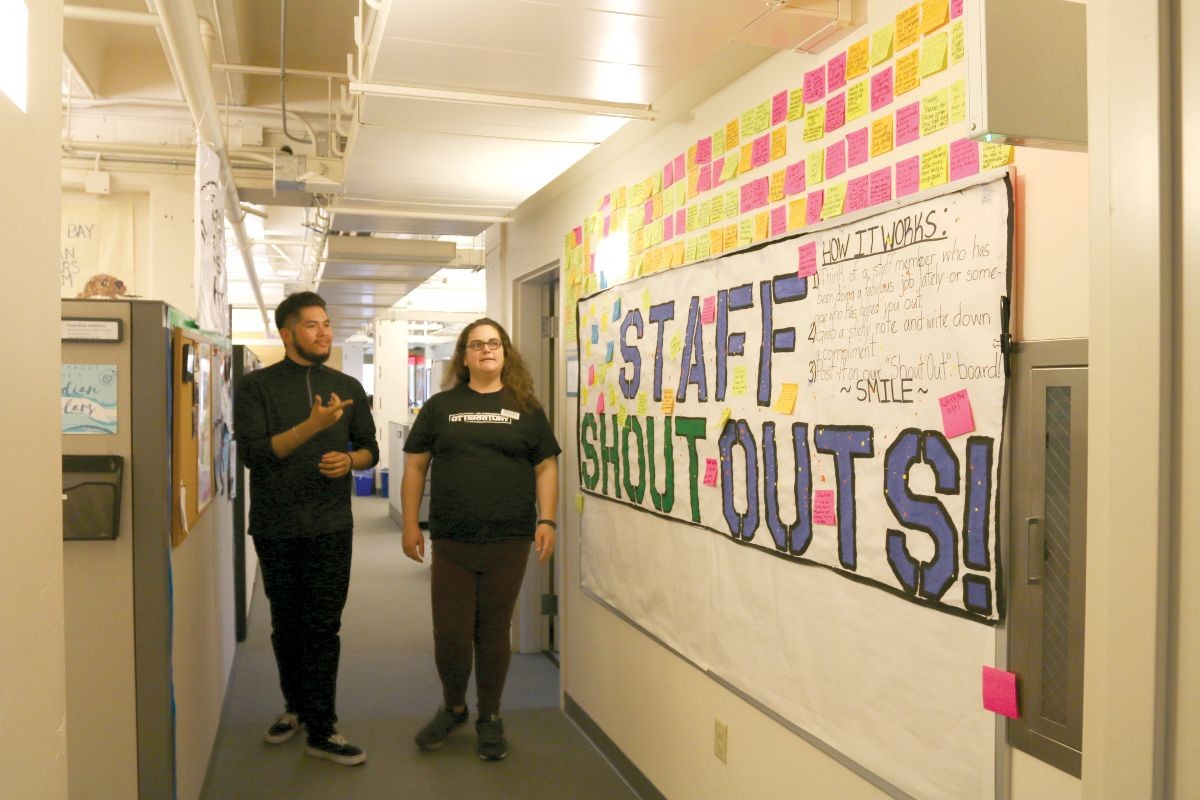
Dedicated to success
Joy Brittain, senior director of CSUMB’s Early Outreach and Support Programs, said, “First and foremost, we have really dedicated and passionate staff who care about the students and want them to succeed.
“Then, I think it is the peer mentors. That relationship piece, both with the peer mentors and the professional staff, is absolutely critical for the success of our students,” Brittain said. “I think the consistency of the contacts is important. It is not just a matter of checking in once or twice a semester, it is an ongoing relationship.”
After the Fall 2017 semester, 95 percent of students served by Student Support Services, and 96 percent of those served by a companion program which focuses on students in the STEM disciplines were in good academic standing. For the CAMP program, 86 percent were in good academic standing.
Retention rates from freshman to sophomore year for the approximately 600 students served by the EOP program have moved from 78 percent to 95 percent over the past three years. The freshman to sophomore retention rate in the CAMP program is 93.5 percent.
The programs have also produced some high-profile success stories.
Daniel Olivares, a participant in Student Support Services, received the U.S. State Department’s Benjamin A. Gilman International Scholarship for the 2017-18 academic year. Olivares is the only recipient from CSUMB and one of nearly 1,000 nationwide. Olivares, an ecology, evolution and organismal biology major, is studying at the University of Cordoba in Spain.
Facing an array of issues
The students served by these programs face an array of issues that go far beyond the classroom.
Kim Barber, associate director of the Educational Opportunity Program and the Guardian Scholars program for foster youth, said these students often have to deal with homelessness and food security issues.
It is not just a matter of checking in once or twice a semester, it is an ongoing relationship.— Joy Brittain
“Coming from that kind of background, there are additional needs that are going to be there. Our students, they do stick around, but they need help in sticking around. They may have a different outlook and different struggles than some of our mainstream students. But they are very bright, and they are very determined because of everything that they already have overcome,” Barber said.
Sarait Martinez, associate director of CAMP, said that about 85 percent of CAMP students live at home to save money and commute to school.
Conflicting pressures at home
Some low-income students also experience conflicting tensions in their homes.
“They feel some pressure to be home working, rather than going to school,” said peer mentor Arthur Munoz, a kinesiology major from Hollister. “So we, as peer mentors, try to allow them to see other options that they may not see when they are under stress. Because when you are under stress in that situation, the options in your mind can narrow down.”
“It depends on what their culture is, and what is expected of them,” said Marie Alonzo, a peer mentor from Salinas who is a collaborative health and human services major. “In migrant households, I think they are more apt to ask the students to stay home, while in other households they do not.”
The hard-earned experiences shared by current CSUMB students add to the supportive environment that helps make these programs successful.
“Students find out that no matter where you are coming from – you are first-gen, you are migrant, you face a financial burden – we are going to help you. We are here to support you in any way possible and we will help you find the answers to your questions,” Martinez said.
A Trail for Everyone
The Fort Ord Rec Trail and Greenway – commonly called FORTAG – is a sprawling three-loop trail that will connect Marina, Seaside, Del Rey Oaks and Cal State Monterey Bay.
The brainchild of CSUMB professors, Scott Waltz and Fred Watson, FORTAG will make the area more accessible for people hoping to get outdoors and enjoy the peninsula. As Watson, a professor in the School of Natural Sciences, explains, they’re not just building a trail system, “but perhaps the nation’s best.”
Before FORTAG, a number of advocates envisioned a trail from the beach to what was, at the time, land managed by the Bureau of Land Management.
“Fred and I came to that project separately,” explains Waltz, an associate professor in Liberal Studies. “But we ended up talking with one another and Fred suggested actually looking, given the current state of development, at what that corridor would look like.
“So Fred started doing some mapping and I started arranging meetings with some folks and talking about the opportunity this presented, and it grew from there.”
240 meetings later
That was an estimated 240 meetings ago.
“We would look at a route and identify stakeholders for that route – landowners, municipalities, community groups,” says Waltz. “Then we just took the time to talk to them and said, ‘We have an idea,’ and we showed them a map that Fred made, and said, ‘Here’s what we think can happen here,’ and then they gave us feedback.”
The work they’ve put in is impressive.— Virginia Murillo
By meeting with every person they could identify who would have an interest in FORTAG, Waltz and Watson were able to build a base of support that astonishingly has led to “no red flags.”
In November 2016, Monterey County voters approved a sales tax increment to fund a number of transportation projects, totaling $600 million. The Transportation Agency for Monterey County (TAMC) identified FORTAG as one of those projects, slated to receive $20 million, with an additional $1 million coming directly from TAMC’s state funding.
That is about half of the total budget needed to make this dream a reality, says Watson.
Next up, an EIR
“The next thing in front of us is to do a formal environmental review. We’re environmentalists and we hug trees, and we side-step every little thing that might be impacted by trail, because it’s a paved trail. It’s fundamentally about enhancing nature through people’s connection to nature and developing stewardship of nature,” Watson says.
TAMC has stepped up to be the lead agency for the environmental review, which Watson estimates will take about 18 months.
The EIR consultant will come on board in the summer, with work projected to last through December 2019, which will then give a “better sense of when the entire trail will be built and what parts will be built first,” explains Virginia Murillo, TAMC project manager for FORTAG.
“[Fred and Scott] have been great partners in all of this,” says Murillo. “The work they’ve put in is impressive – outreach and out in the field, gaining public support. It’s a great example of grassroots work, all while being professors.”
Once the EIR is certified, contracts will go out for final design and construction, a portion of which will depend on finding additional funding sources.
“It’d be great to start digging tomorrow,” says Watson, “but it’s more about knowing that we’ve got something really good, and whatever time it takes to make that happen it will take. It’s one of the luxuries of being a professor at a university. The university is invested in us and the ability to be a part of our community in the long term.”
Support from CSUMB
The professors say that CSUMB’s backing proved to be a huge turning point for the project.
“The university has been extremely supportive and recognized the value of this trail for students and for the university community,” Waltz explains. “President Ochoa stepped right up and said, ‘This is a good idea, we encourage you to put together an MOU, and the university would be happy to look at it and sign it.’”
Waltz and Watson also said CSUMB planning staff has been very supportive.
“We have been absolutely folded right in to the Master Plan. So the university hasn’t just been supportive, they’ve basically said, ‘We want part of this to be ours for our community,’” says Waltz.

Three loops
“If you pull back and look at the whole trail route you can imagine it as three loops or three wheels,” Waltz says.
“There’s a circuit that traces around the city of Marina and reaches out into some of the areas just beyond Marina that are largely undiscovered at this point. There’s a loop that goes down and follows the rec trail to the Canyon Del Rey area, that goes through the parks there, that we call our sort of ‘string of pearls,’ and then comes into Del Rey Oaks and up.
Across the whole system we want to create opportunities for people to do outdoor art installations, or outdoor yoga pads, or painting clubs, or birding clubs...— Fred Watson
“There’s also that middle loop that you can trace around CSUMB. That was not an accident. So CSUMB sits in the middle of the middle loop of the FORTAG route.”
“The whole thing, combined with the coastal rec trail, is over 30 miles,” says Watson. “And we’re about to build 25 of it and it is absolutely crucial that this thing is safe from many perspectives of safety – so that you are not just safe but you feel safe.”
FORTAG will also be accessible.
“People with a cane, people with a sore hip, people on a walker, people in a wheelchair, people on training wheels, people who know they wanna walk but the last time they did it there was a hill and it was just a drag,” explains Watson, “Just everybody in that category now where it just isn’t quite that easy to go for a walk, we wanna grab all them and say ‘Hey, this is not just easy but this is right there in front of you. You just gotta feel like doing it.’”
“The accessibility allows for paralympics and para-athletic events, which are taking place in the region, and we could create a perfect event course for that, too,” adds Waltz.
Something for everyone
Watson hopes the trail draws people from all walks of life.
“Across the whole system we want to create opportunities for people to do outdoor art installations, or outdoor yoga pads, or painting clubs, or birding clubs, lot of opportunity for native plant restoration - at the professional level but also at the level of getting kids engaged in creating a native planted landscape and maintaining that. For youth fitness programs, both formally through public schools and private schools, and also informally.
“The whole thing around the outside is 26.2 miles, which is a marathon. The Marina loop is 13.1, which is a half-marathon.”
Ever the professor, Watson currently has three grad students “working on a project to do all this detail survey in a place where we need to do a tricky bridge undercrossing. It’s pretty exciting to finally start plugging the teaching and learning experience into all this.”
Waltz adds, triumphantly, “FORTAG will be the birth of a thousand capstones!”
Unlocking the Gene’s Secrets
Keck Foundation grant helps modernize the study of biology
Assistant professor Nate Jue checks his phone as he walks to his lab. “I’ve got great news!” he tells his colleague, assistant professor Eric Crandall, as they pass in the hallway.
Jue just received confirmation that an acquaintance’s test for cancer is negative. But the determination was done using conventional, invasive means.
In the future, Jue says a small blood sample and hardware that fits in your pocket will reveal “trace biomarkers in your blood ... they will be able to determine whether or not you might have indicators for cancer.”
That future may be arriving in Jue’s lab in the Chapman Science Academic Center.
Keck Foundation grant
Last summer Jue announced a $300,000 award from the W. M. Keck Foundation to help modernize the way CSUMB teaches biology. Instead of working at the genetic level, CSUMB students will now be able to work at the genome level and use a relatively new field of study to analyze large sets of data.
But according to Jue, this will not be limited to a single course, as it is with most universities. “We’re really trying to affect our entire biology major,” Jue says.
In addition, Jue and eight other colleagues see this as an interdisciplinary tool. This means a student attending any class in the School of Natural Sciences will be able to “apply the methodologies of genomics and bioinformatics to the type of biology” that interest them.
Understanding genes
Genomics allows a researcher to understand the entire set of genes in a cell or organism. The genome is the blueprint for how an organism builds and maintains itself, and genomics allows a researcher to draw that blueprint.
But acquiring that information means analyzing enormous data sets on dedicated servers.
The core of Keck is to implement course-based undergraduate research experiences into classes— Professor Jue
Bioinformatics allows a researcher to use computer software to pour through data sets in the hundreds of terabytes.
Jue teaches both in his course work. “People like me who do both will be more common in the future,” he says.
Analyzing DNA strands
In Jue’s lab on the third floor of the Chapman building, he pulls out a device the size of a stapler called a MinION. It can produce a sequence of DNA strands thousands of chains long in just a few minutes.
This device connects to a laptop via a USB cable. “It means you could conduct real-time monitoring of ebola breakouts in Africa” rather than wait for results to be sent back to labs in developed countries, he says.
In the next room is a much larger device called MiSeq that can sequence millions of chains.
Jue’s primary research is on genetic diversity of marine life (1). He and his students will use these tools to identify and understand how genetic changes affect organisms.
But these tools are the same for any concentration in biology. “You can be a genome/bioinformatics person who does ecology or cancer research,” explains Jue. “All those things apply.”
And that is a different skill set than what is traditionally taught in biology.

Genomics and bioinformatics
When Jue was an undergraduate, the “high tech” in his classroom was the ability to study the biology of cells using fluorescence and microscopes.
“When I was an undergrad in the late 1990’s, genetics was still pretty limited in what it could do,” Jue remembers. “The human genome wasn’t officially sequenced at that point.”
That wouldn’t come until 2001; the advance cost $3 billion. “Now it costs about a $1,000 to sequence the human genome,” Jue says.
That’s because of technological advancement, not just demand. Over time, the cutting-edge tools in the classroom became tools of the trade in the industry.
With Jue’s lab equipment, today’s students will be able to enter contemporary biological professions where genomics is an established field and bioinformatics is the tool of the trade.
More research opportunities
The Keck grant allows Jue and his colleagues to develop more research opportunities for undergraduates.
“The core of Keck is to implement course-based undergraduate research experiences into classes,” Jue explains.
The Undergraduate Research Opportunities Center (UROC) has successfully developed that for students involved in UROC research. Jue and his colleagues want to democratize that for the rest of the student body in collaboration with UROC.
He first has to build the infrastructure with the sequencers, the hardware that allows students to identify DNA.
Next comes creating a new concentration in the biology major in genomics and bioinformatics.
Lastly, Jue and his colleagues will blend these new fields into the entire biology curriculum.
It has already led to opportunities to conduct important research, including a study of the genome of great white sharks, conducted with scientists from the Monterey Bay Aquarium.
Viral genomes
Studying marine viruses has a distinct advantage, especially for new students.
“Viral genomes are a lot smaller than [animal or plant] genomes,” says Jue.
We’re really trying to affect our entire biology major.— Professor Jue
Freshmen could go out on the Monterey Bay, take some samples and come back to the lab to study them with new equipment.
In addition, there’s a real need.
“We know very little about marine viruses in general,” he explains. Because bacteria found in the ocean are a main source of carbon, it’s important to understand when marine viruses infect bacteria and kill them off.
Researchers like Jue use genomic techniques to improve our understanding of the diversity of life.
“In the past, you would have focused on just one virus or perhaps just one gene; now you can take a water sample and amplify one gene to identify what organisms are in the Monterey Bay or describe the entire genomes of organisms such as viruses in order to deepen our understanding of ecosystem biology." (2)
That gene could come from a larva, a red tide or even a whale, according to Jue.
“We’ll hopefully get a better understanding of what the viral dynamics are out in the ocean.”
Footnotes
(1) Updated from the print version to more broadly reflect Professor Jue's overall research interests.
(2) Updated to further describe the technique.
Playing by the Rules
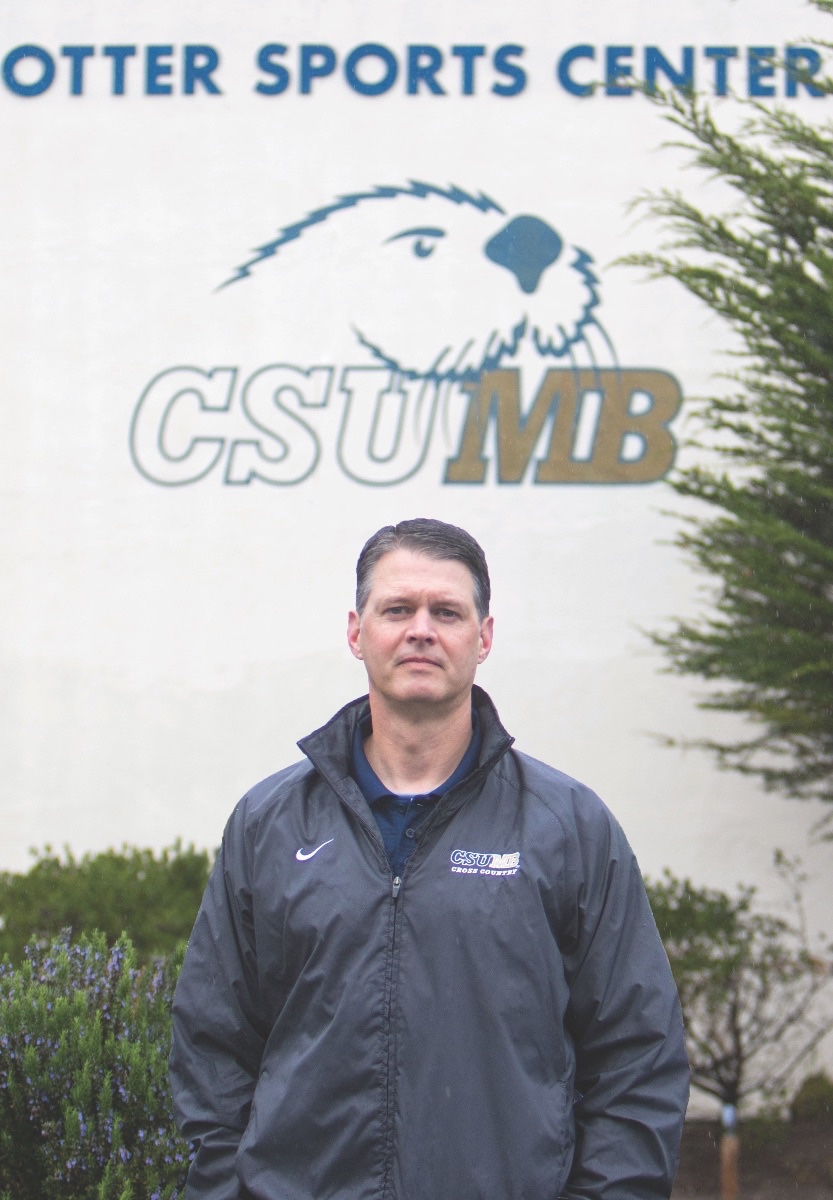
Division I athletics, as administered by the National Collegiate Athletic Association, is well-known – some would say notorious – for a complex and voluminous rule book.
Division II athletics, in which Cal State Monterey Bay competes, is a bit different, according to Greg Harrod, the Otters’ assistant athletics director for compliance.
“In Division II, there aren’t as many rules, but as you can see, it is still over 300 pages,” said Harrod, holding up the book that sits on a prominent place on his desk.
Much of the difference, Harrod said, results from the far higher financial stakes that are in play in major college athletics.
Tight limits
“The more money that’s involved, the more trouble you can get into. Most schools at this level don’t have enough money to get into a lot of trouble. We’re not paying players, we’re not going out and renting cars for them, we just don’t do that,” said Harrod, who was a track athlete during his college days at Pittsburg State University.
As opposed to the complex Division I calendar, which spells out “dead periods,” “quiet periods,” “contact periods” and “evaluation periods,” Harrod said, “Division II is much more straightforward. Basically, we have times we can watch a kid but not talk to him, but other than that, it is a free for all.”
Division II athletics have tight limits on total number of scholarships in each sport: almost all scholarships awarded are partial ones.
“We have to go out and see more kids, because we are not offering a full scholarship,” Harrod said. “We have to cast a wider net, because there is so much competition to get those athletes.”
I think in 10 years, people aren’t going to recognize what Cal State Monterey Bay has become.— Greg Harrod
Meanwhile, Division II squads typically have only a head coach and perhaps an assistant to cast that net.
“For the coaches, (recruiting) is their second full-time job,” Harrod said. “In Division I (football), you probably have 10 or 15 guys looking at film, and saying we want to talk with this guy and then you send one of your assistants out to do that. Our coaches do it all on their own.
“For example, right now it is baseball and softball season. So, not only do our coaches run practices every day with games on weekends, they also spend some weeknights on the road watching junior college and high school games.”
Figuring it out
Under Division II rules, CSUMB is required to maintain extensive records on recruiting contacts and how much time Otter athletes spend each week in practices and games.
The issues that arise tend to be “just weird mishaps. We send the wrong email to a kid; it was too early, he was only a (high school) sophomore and the coach thought he was a junior,” Harrod said.
“I also look at a lot of eligibility stuff. A lot of our teams are junior college transfer heavy, so I spend a lot of time looking at junior college transcripts, figuring out, ‘Does this kid have enough hours? Did he take too many PE classes?’” said Harrod.
New beginning
He came to CSUMB in 2014 after working at McMurry University in Texas. The administration was planning to move the university from Division III to Division II, which would require a full-time compliance director. However, when new leadership decided to stick with Division III, Harrod went job hunting.
He sounds glad to have landed where he did.
“I have no reason to want to be anywhere else. One of the things that appealed to me when I got here is that right now, this school is still at the beginning. I think in 10 years, people aren’t going to recognize what Cal State Monterey Bay has become,” Harrod said.
“In 10 years or so, hopefully we will be at 12,000 students and be one of the premier state schools.”
A Passion for Advocacy
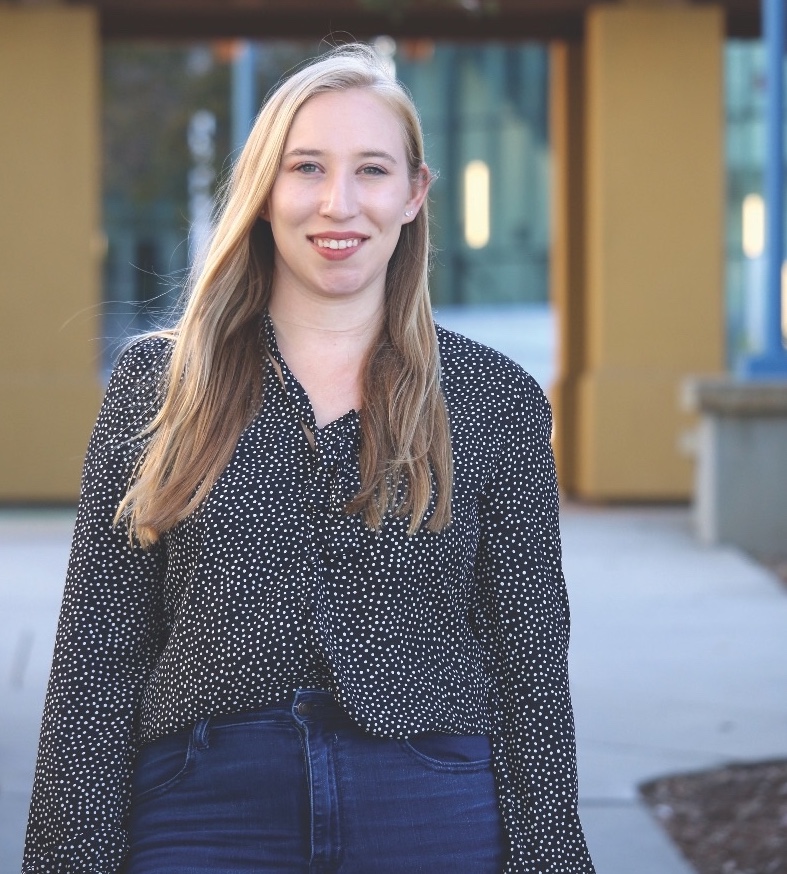
Lauren McClain believes that personal outreach is the most effective way to build interest in serving in student government.
And she should know. She got started on the path toward serving two terms as Associated Students (AS) president at Cal State Monterey Bay because of a classroom presentation.
“This girl came to one of my classes and she said there was an opening at AS for a chief financial officer,” McClain recalled. “And that was about a week after I had decided that I wanted to become an accountant. She gave me an application form and it sat on my desk for a week or two, because I didn’t really know what AS was or if I wanted to do it.”
Eventually, she applied, was interviewed, and got the job.
From cheerleader to advocate
McClain had been a cheerleader through her years of high school in Durango, Col., and tried that for a year at CSUMB, before focusing her attention on moving up through student government.
...that is what Associated Students is for, to bring those voices up.— Lauren McClain
“I decided I had a real passion for advocacy. I didn’t just want to work with the numbers. I wanted to have more free time to advocate for bigger issues and work with more people here on campus,” McClain said. “So I ran for president.”
She ended up serving the last two academic years as AS president; it is believed to be the first time that has happened at CSUMB.
During her tenure, one area of focus for AS has been expanding the food pantry program, which distributes healthy, free food to students four times a semester. A CSU study released in early 2018 found that 41.6 percent of students system-wide experienced some level of food insecurity.
A voice for students
McClain also has been involved in an ongoing effort that is more under the radar, the allocation of space around campus.
“It is not a beautiful topic and it is not super fun. Students tell me what they want and they tell others what they want, but it is really hard to make those voices louder,” McClain said. “There are people who want a Dream Center, cultural and identity groups really do deserve their own spaces. We want a permanent space for a food pantry.”
I decided I had a real passion for advocacy.— Lauren McClain
“I think students could be more vocal on this, but at the same time, that is what Associated Students is for, to bring those voices up.”
Many of the efforts of the AS under McClain’s leadership have involved “trying to make sure that students are seen as really key stakeholders on this campus, seen and respected.”
Future plans
After her graduation in May with a degree in business, McClain plans to attend graduate school at UC Davis to earn a master’s degree and a CPA license.
Then, her path could lead her to a business whose values she shares, or back to higher education.
“Not so much in student affairs, which I know is more popular among people who have been in student government, but more on the financial side of things,” McClain said. “I think there are more things we can explore, as far as looking at options that would shift some of the costs from the backs of students. So I may be interested in looking at that.”
Natural Born Leader
When Gilbert Bernabe sat down at his first CSUMB Student Veteran Organization (SVO) meeting in 2016, he was the newest face in the room.
As a new transfer student from Hartnell College and unfamiliar with the seating arrangements around the table, he sat down in the first vacant seat he found. Little did he know, that vacant seat was reserved for the SVO president, and nobody currently held the position.
By the end of his first meeting, that seat was his and it still is two years later.
A desire to help others
It should come as no shock that Bernabe could show up and become president of the SVO on his first day. His desire to help others is evident when you meet him and he brings a wealth of experience working within the local veteran community of Monterey County.
“While I was at Hartnell, I was involved in the student veteran organization, too, the Hartnell Veterans Club, and I served in every position from secretary to treasurer to vice president and president,” Bernabe said.
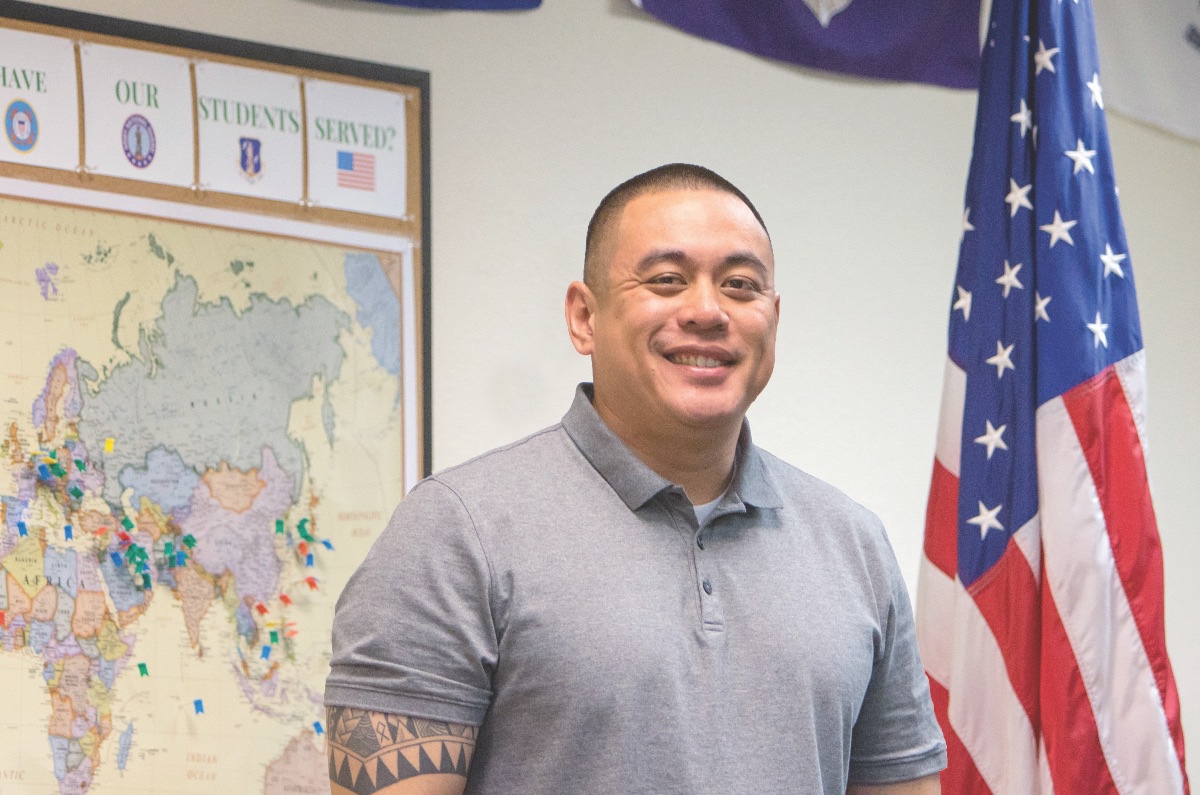
Bernabe was born and raised in Salinas. After high school, he spent seven years working locally before joining the Army. While on active duty he served in a variety of positions ranging from human resources to tank crewman, and finally as a combat engineer. After he ended his active duty, he went on to serve four more years in the California Army National Guard.
Military to civilian
Transitioning from the military to a civilian or academic setting poses a set of challenges unlike those facing most students. While in the military, someone is always giving you direction. You’re told when to eat and when to sleep and how to fold your clothes. In college, there is much more independence and self-reliance. Finding a network of people who share your experiences is one of the best ways to overcome those new, often underestimated, challenges.
Bernabe credits the Hartnell Veterans Club for helping him with that transition.
“When I was a new student at Hartnell, the veterans club really helped me. I feel like I may not have graduated community college if I didn’t have that network. And now I get to do the same here and help other new students navigate college.”
We wanted to expand beyond just the student- veteran communities and get everyone in the community involved.— Gilbert Bernabe
Through that experience, he realized that he wanted to be involved in helping others in the community. He started a nonprofit organization in 2015 called the California Veterans Club, which aims to help all of the local veteran organizations collaborate with each other and take advantage of the resources that are available to their members.
“We wanted to expand beyond just the student- veteran communities and get everyone in the community involved,” he said. “My good friend who started the California Veterans Club with me just started class at CSUMB this semester. I think he could be the next SVO president as he is very involved in the veteran community too.”
Major improvements
In Bernabe’s two years at CSUMB he has seen some major improvements to the veterans center and also the increased activity of the club. In spring 2017, the Veterans Resource Center at CSUMB received a new refurbished space thanks to a generous donation by The Home Depot Foundation.
While he credits Giselle Young, CSUMB’s veteran services coordinator, with doing most of the work to secure the grant, Bernabe worked with the Salinas Home Depot to help pick out new carpeting, furniture and other items to refurbish their space.
“This new space really is all thanks to the work of Giselle and the sponsors for making the resource center feel as welcoming as it does now,” he said. “There are definitely more people hanging out and studying in here. We spend a lot of time in here and help each other study or just hang out and eat lunch. I’d really encourage more students to stop by.”
A great experience
“It has been a great experience and really rewarding to see our student-veteran community expand here and see the resource center be remodeled. I will miss it, but I know the next president will do great and I won’t be far away.”
Bernabe is set to graduate in Fall 2018 with a degree in business and a concentration in marketing. He says he’s keeping an open mind and keeping his options open for what comes next.
Building Bridges
Compiling, communicating campus crime statistics requires a collaborative effort
The Jeanne Clery Act requires campuses nationwide to keep and disclose accurate information about crimes that happen on or near their campuses.
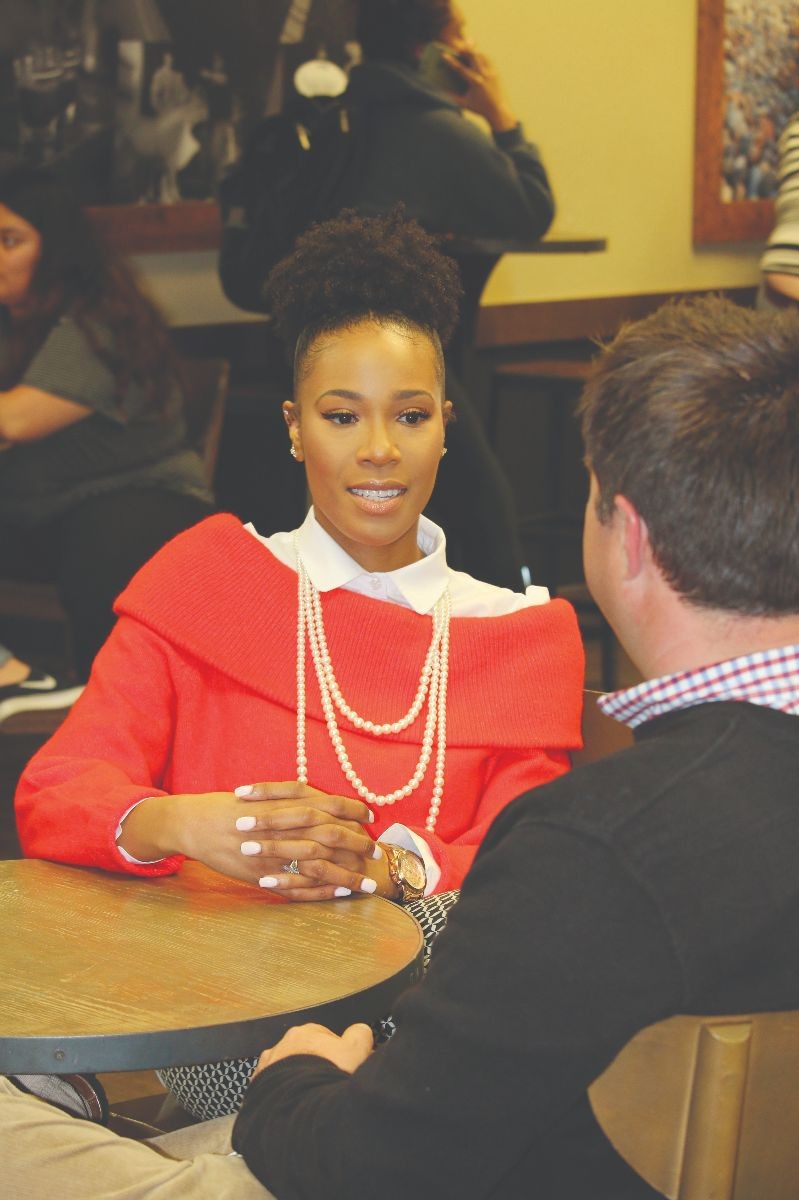
So, Shanieka Jones, who is in charge of Clery compliance at Cal State Monterey Bay, knows that the numbers are important. Perhaps even more important are the relationships she maintains across campus.
I cherish the time I am able to spend with students.— Shanieka Jones
“You have to be personable. I think any employer wants that. But I have found with Clery, that it carries with it this huge weight. And if you constantly find yourself saying: ‘But we could get fined,’ or if you are always telling departments what they are doing wrong, you are burning bridges before you can build them,” Jones said.
In the wake of high-profile sexual misconduct cases that have roiled campuses such as Michigan State and Penn State – as well as fines issued by the U.S. Department of Education to campuses found not to be in compliance with Clery – universities are making renewed efforts to be certain they are abiding by the letter of this decades-old federal mandate.
Providing important information
Not surprisingly, Jones is a strong believer in the importance of the law, which requires campuses both to make annual reports of crime statistics and to issue timely warnings to the campus when criminal activity occurs.
“It allows prospective students and employees to make an educated decision on whether or not they consider that campus safe and whether they would want to attend or work there,” Jones said.
“The other side of it is that I think it helps build bridges to departments that might never talk to each other otherwise.”
When CSUMB was looking for a Clery Act and crime prevention coordinator in 2014, it didn’t take long for the hiring committee to decide they had found the right person in Jones.
“We conducted a video interview with Shanieka and right away it became obvious that she had a strong understanding of Clery and the challenges of campus compliance,” said CSUMB Police Chief Earl Lawson.
“The entire interview panel was impressed with her professionalism, charisma and articulate answers to the panel’s questions. Before we even ended the interview, panel members had whispered among themselves and slipped me a note encouraging me to invite her to visit CSUMB.
“Sometimes you just know you’ve found the right person.”
An HBCU graduate
Jones grew up in a close-knit family on Long Island, and, when it came time to go to college, moved to Virginia to live with her grandparents.
Her grandfather, who had retired from the Nassau County (N.Y.) Police Department, had his own idea of where Jones should further her education.
“He had some personal views on race relations, having grown up as a black man in the south, and he said, “If I am going to help pay for your school, you are going to go to a HBCU (historically black college),’’ Jones said. “First I resisted. Then he and I sat down and had a serious conversation, and I said I would give it a try, and I ended up falling in love with it.”
She attended Virginia State University, where she earned both a bachelor’s and a master’s degree in criminal justice.
“Being introduced to my culture in a whole new way, it allowed me to learn who I am as a black American,” Jones said.
Into law enforcement
She took her first law enforcement related job as a parking manager and then records manager at Virginia State. One day she ran into the campus police chief who was heading for a meeting and he asked her to join him. It was about the Clery Act.
“I left saying, ‘What in the world is this? And whatever it is, I don’t think we are doing it right,’” Jones said.
She oversaw Clery Act compliance at Virginia State for three years.
Right away it became obvious that she had a strong understanding of Clery and the challenges of campus compliance.— CSUMB Police Chief Earl Lawson
“Slowly but surely, Clery became me. I guess I had a knack for it. I have kind of a type A personality, being able to organize things, and read things, to the letter.”
She then began checking for other jobs in the field, and came upon the announcement of the position at CSUMB.
Moving to Student Affairs
In 2017, the CSU mandated that all of its campuses have a full-time Clery compliance director, and that the position be independent from the campus police department, to avoid potential conflicts of interest.
Jones now reports to Student Affairs and has moved away from her crime prevention responsibilities, which had her giving presentations to a wide range of administrative, faculty and student groups around campus.
“That satisfied my personal passion. I am really big on community policing, community outreach, community service in general,” Jones said. “I cherish the time I am able to spend with students. Even in this position, I have maintained my role as the adviser to the Black Students United on campus.”
Still, she is happy with her current role.
“I for one am extremely grateful to university administration. I have not felt any resistance to anything I have proposed. Even when I am presenting the numbers to cabinet, I never get responses that make me wonder why I do what I do. The response is: ‘Here are the numbers. How are we using these to educate, to program?’’’
“As long as I am getting that response, I know that CSUMB’s heart is in the right place.”
Library Event Celebrates Farr Legacy Collection
When future historians and students seek to understand the public policies and political history of the late 20th and early 21st centuries on the Central Coast, they will find a unique resource in the Tanimura & Antle Family Memorial Library.
The Farr Legacy Collection will be housed in the library, which serves as the academic hub of the CSUMB campus. The collection consists of nearly 200 boxes of documents, plus images, sound recordings, other media and digital files from the careers of Fred and Sam Farr.
People come up to me and say ‘Thank you for your service,’ I tell them, “Thank you for hiring me!"— Congressman Sam Farr
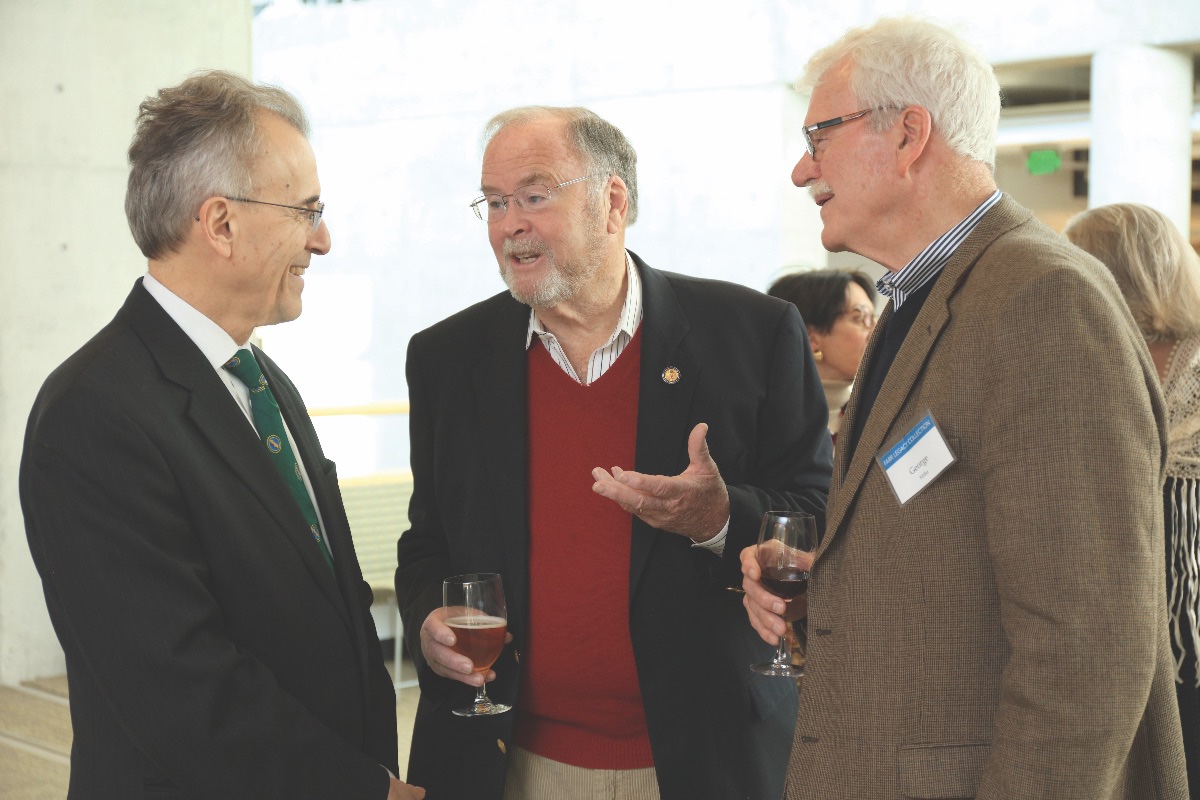
At a March event recognizing the collection, Sam Farr talked about the importance of public service and the role he hopes the papers will play in helping to inform future generations of political leaders.
“What we’re celebrating today is not my role or my father’s role. We are just part of the story about the importance of public service,” said Farr, who served as a congressional representative from the Central Coast for more than two decades. Prior to serving in Congress, Farr was a member of the Monterey County Board of Supervisors and the California Assembly.
His father, the late Fred Farr, was a long-time environmental leader who served for more than a decade in the California State Senate.
Dynamic democracy
Surrounded by friends, colleagues and supporters from his long political career, Sam Farr talked with pride about the parks that had been created and the environmental protections that had been enacted through his work and that of his father. Sam Farr also played a key role in the effort to create Cal State Monterey Bay.
“What I think is so important about these papers is that, someday, people may wonder how all that happened,” Farr said. “We want to demonstrate that there are ways to petition the government; there are ways to change things. We live in the most dynamic democracy in the world.
“It is all about you. People come up to me and say ‘Thank you for your service,’ I tell them, “Thank you for hiring me,” Farr said.
In his remarks, Library Dean Frank Wojcik said, “I look forward to the day when university classes meet in the archives and students can connect to the history of our institutions and society through the Farr materials.”
Wojcik said that the university has a fundraising goal of $200,000 to support the work involved in organizing and creating the archive and making it accessible to the public.
Saving the Reefs
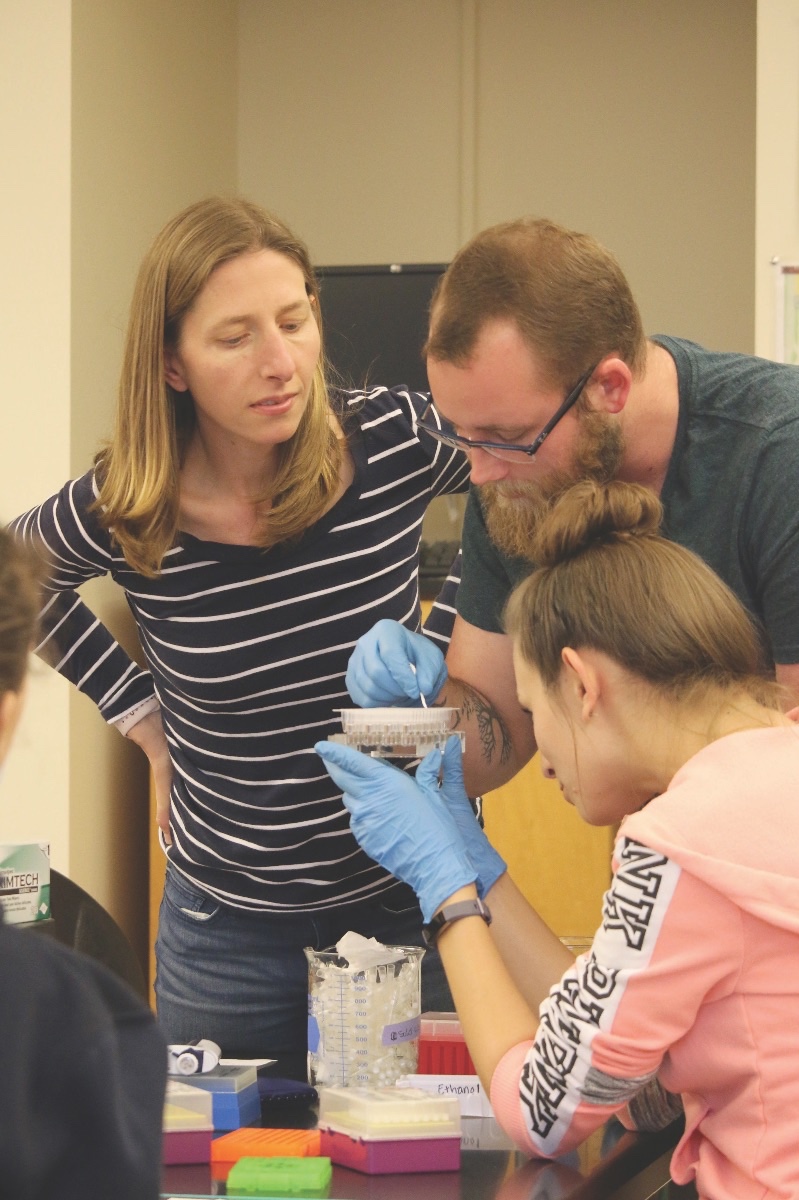
School of Natural Sciences associate professor Cheryl Logan has been part of a number of research teams looking into the health of coral reefs. We talked with her about her role as one of 12 members of an international committee appointed by the National Academies of Sciences, Engineering, and Medicine to look at the future of the reefs and about the challenges faced by women as they advance in STEM fields.
What is the goal of this committee?
Logan: Our task is to look at possible human interventions back on the reefs.
Bleaching is the process by which the colorful symbiotic algae that live inside corals are expelled – bleaching corals are bright white. This is bad because the algae provide corals most of their food. Bleaching doesn’t necessarily kill the corals, but if it is sustained over a long period of time, it can lead to mortality.
Within the United States’ jurisdiction, the primary concern is coral health in the Caribbean. In addition to warming, there has also been disease within the Caribbean corals, so they are not doing well at all.
Right now, we are on track for the worst-case emissions scenario.— Cheryl Logan
It is the responsibility of the National Oceanic and Atmospheric Administration (NOAA) to manage these reefs. Traditional management tools like marine protected areas have not been working, so NOAA wants to look at other interventions, such as moving heat-tolerant corals from places where they are doing well into the Caribbean, to see if they could potentially take hold there. They are also looking at things like artificial evolution, bringing corals into the lab, exposing them to warmer temperatures and trying to increase their thermal tolerance. The idea is that these more tolerant corals could then be out-planted back on the reefs.
The goal of this committee is to review the best available science regarding the possible benefits and risks of human interventions and come up with a decision framework that managers could use to decide whether they want to try to implement some of these strategies.
Why is the health of coral reefs so important?
Logan: Coral reefs are among the most bio-diverse ecosystems on earth, similar to rain forests. They provide habitat for fish and fisheries that a lot of people depend on for food, especially in smaller island nations. There is also the protection the reefs provide, from storms and waves. And then, of course, there is tourism. Coral reefs are places corals, so they are not doing well at all. people want to go SCUBA diving and snorkeling, to see the diversity of corals, fish, turtles and sharks.
You have worked on research that indicates, to a certain extent, the reefs are resilient and can bounce back. Under what circumstances can that happen?
Logan: Most of my coral reef research has been in modeling the future of corals in response to climate change. We use the output from global climate models, which tell us how the temperatures are expected to change in the next 20-50 years. Then, considering the physiological thermal threshold of corals, we can predict how corals would respond based on rising sea surface temperatures.
Our results depend largely on the greenhouse gas emissions scenario that we project. Right now, we are on track for the worst-case emissions scenario. Under those conditions, even when we include the ability of corals to acclimate or adapt to some extent, corals won’t be able to survive through the year 2100. Under lower emissions scenarios, we do see the possibility that corals could persist if they are able to adapt to the rising temperatures.
Moving in a different direction, the issue of getting more women into the STEM fields is attracting more attention these days. What do you see as the issues there?
Logan: Within the field of biology, at the undergraduate level and even at the Ph.D. level, it is actually more than 50 percent female at this point, so we are graduating more biology Ph.D.s that are women than men. But then there is the pipeline issue. As you go from Ph.D. to a post-doc, and then to the assistant and associate and full professor level, there is a huge drop-off.
When women graduate from Ph.D. programs, it is typically the time of their life that they are interested in starting a family. There is a penalty to your research productivity, especially at universities where tenure decisions are driven by number of publications. The productivity hit you take by starting a family when you are just beginning an assistant professorship can make this a very stressful time.
At the same time, some of the top coral biologists in the world are female. I have hope that things are getting better for women in science, but we need institutional changes. We need more family-friendly policies to encourage women to stay in academia, and modifications to the tenure process that don’t penalize women for starting families. And some of these changes are happening now.
What’s next for you?
Logan: I was awarded a Fulbright Fellowship to go to the Galápagos Islands next year to study coral thermal tolerance. During natural El Niño events, water temperature can get quite high and lead to bleaching. During the 1982-83 El Niño event, it knocked out about 90 percent of the corals in the Galápagos. But since then, among the corals that did survive, they appear to be more tolerant than expected. So part of my proposed project is to examine corals’ thermal tolerance windows and then take samples for genetics to understand if some of those corals are better adapted to changing temperatures.
In fact, my husband and I, both applied for Fulbrights, and he was also awarded a fellowship. He is a senior research scientist at the Monterey Bay Aquarium and will be studying hammerhead shark nurseries. So we are going to take our whole family – we have a two-year-old and a four-year-old – and live in the Galápagos for five months next year.
Bringing Fossils to Life with Illustration
CSUMB science illustration certificate program graduate Andrew McAfee (2015) has watched his latest illustration go from being a secret on his computer to receiving international attention.
The illustration – a life reconstruction of the titanosaurian dinosaur Mansourasaurus shahinae – has been featured in global media outlets, including National Geographic, The Washington Post and Nature.com.
Secret project
“It’s crazy how much attention it is getting. Especially because we had to keep it a secret the whole time until it was published,” McAfee said. “I worked on it for months and it was just this secret project on my computer that nobody knew about and then, after we released it, it’s just showing up everywhere. It’s just surreal.”
This recently discovered species in the Sahara Desert of Egypt has helped scientists from Mansoura University in Mansoura, Egypt make an ancient connection between Africa and Europe.
“They discovered the first specimens in Egypt in 2013 and the lead paleontologist there, Hesham Sallam, contacted some other paleontologists to help him work on it, including Matt Lamanna, who is my boss here at Carnegie Museum of Natural History. So he was involved in publishing the scientific paper.”

A stroke of luck
Since McAfee is currently working as the scientific illustrator for the vertebrate paleontology department at the Carnegie Museum of Natural History in Pittsburgh, PA, he was asked to help with illustrations for the paper.
“I was truly just very lucky to be asked to do the illustrations. I did the illustrations for the paper but I also had the chance to do the life reconstruction which is the painting that everyone has been seeing in the news.”
It wasn’t merely a stroke of luck, however, that McAfee was selected for the illustration of this project. He has put in a lot of time and effort to get to this point in his career.
After graduating from the University of Mary Washington in Fredericksburg, Virginia with a degree in biology in 2004, he joined the Peace Corps and served two years in Guatemala.
From passion to profession
“I always loved doing art and I majored in biology undergrad, but I hadn’t really combined the two. While I was in Guatemala for two years I was doing these drawings of the people and animals. Then, when I got out of the Peace Corps I was trying to think of a way to combine the art and the science and that’s when I found out there was a profession for science illustrators.”
He was able to line up a few professional illustrations for a company in Hong Kong and illustrated a textbook for Oxford University Press, but wasn’t sure what to do next.
“I was living in Philadelphia at the time and the Academy of Natural Sciences had a science illustrator, so I arranged to meet with him. His name was Scott Rawlins. He explained what he does and what his career is and he suggested I join the guild of science illustrators.”
He attended the annual conference for science illustrators and that is where he was introduced to the CSUMB science illustration certificate program.
“The conference is where I heard about CSUMB’s program being the premiere program in the country. I actually spoke with Diana Marquez and some alumni of the program who suggested that I work up a good portfolio and apply.”
It takes discipline
McAfee credits the program with advancing his skillset and exposing him to other forms of media used to create science illustrations.
“It was a year of living and breathing illustration and being around people who are illustrating and working with some incredible artists. I was really saturated with thinking about illustration and it was so valuable.”
“The program also increased my technical range and versatility. There were a lot of different techniques in both traditional and digital media that I was exposed to there and that helped me diversify my skills and techniques.”
While he credits the program for helping him advance himself professionally, McAfee did offer some humble advice for anyone considering applying.
“Prospective students should know that it’s a serious, fast-paced program. That’s why it is such a great program. It takes discipline. It is very intensive and it is hard work,” he said. “But that is reflective of the industry. Science illustration is a competitive industry so I tell people who are interested in pursuing it as a career to take is seriously and to be aggressive.”