News Information
- Published
- November 3, 2026
- Department/College
- College of Science, University News


Kali Prescott's Fulbright-National Geographic Award is helping to fund her research in New Zealand.
By Mark Muckenfuss
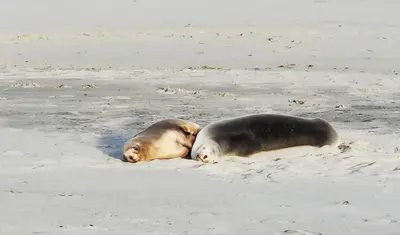
Near the bottom of the world, scientist Kali Prescott is trying to help keep an endangered species of sea lion from vanishing altogether.
The Cal State Monterey Bay alumna is tracking the feeding habits and reproduction of the New Zealand sea lions – a breed similar to the California sea lions in Monterey Bay – on remote Campbell Island, about 400 miles beyond the tip of New Zealand’s South Island, on the way to Antarctica.
“They’re very, very rare animals,” Prescott said. “There are only about 10,000, and only about 5,000 adult animals.”
A postgraduate student at the University of Otago in Dunedin, New Zealand, her work is being funded, in part, through the Fulbright U.S. Student Program and the Fulbright-National Geographic Award. Prescott said only five Fulbright fellows were chosen for the combined award, which was established in 2013. It provides an additional $20,000 to students in order to present their work narratively to “mobilize global communities, create mutual understanding and build a more peaceful world,” according to the Fulbright website.
Campbell Island is home to about 20% of the New Zealand sea lion pup population. In recent years, the first-year mortality rate among the pups is as high as 80%. Prescott and the team she is working with will be trying to determine why.
Most of the pups, she said, die from exposure or starvation. Scientists suspect that extensive fishing in the region, along with factors related to climate change, are reducing the resources the sea lions rely on for survival.
“The goal is to get more trackers on them and see why the population is in freefall,” she said.
They will be looking at foraging patterns as well as taking blood and whisker samples to determine what food the animals have been eating.
“It's a matter of how we can protect the species and still allow for some kind of fishing,” she said. “It’s very difficult.”
A 2017 graduate of CSUMB, Prescott earned a bachelor’s degree in biology. She went into research and, while teaching classes at CSUMB, worked on a master’s degree in marine science at Moss Landing Marine Labs. She received that degree in 2024.
She said CSUMB gave her opportunities to pursue her interests.
“I had access to research programs, and I was given a lot of responsibility as an undergrad,” she said. Working with professors Arlene Haffa and former faculty member Jenifer Zelig, she added, “made me very confident with aspects of research that a lot of folks don’t have until they get to their PhDs.”
Initially, she had planned to pursue a doctorate in the U.S. But with federal grant cuts, the research programs she was considering, she said, “didn’t have reliable funding to support me. New Zealand offered me a full ride, plus I won the Fulbright fellowship.”
She feels her experience with CSUMB and Moss Landing gives her an advantage.
“Most people here have given me the feedback that I'm very capable,” she said of her New Zealand colleagues. “They’re surprised by how far along and how much thought I’ve given things, since I just started.
“This is a very large, very prestigious and very old university in New Zealand,” she added. “The expectations for you as a student here are a fair bit higher. As part of my application, I had to submit my master’s thesis. It was graded a high A to an A-plus.”
Looking back, she said, the education she received at CSUMB and Moss Landing was key to her success.
“I’m very appreciative,” she said.
Cal State Monterey Bay is not an official site of the Fulbright Program or the U.S. Department of State. The views expressed on this site are entirely those of Cal State Monterey Bay and do not represent the views of the Fulbright Program, the U.S. Department of State or any of its partner organizations.