News Information
- Published
- November 24, 2026
- Department/College
- Information Technology, Office of the President, University News
- News Type
- News Topics


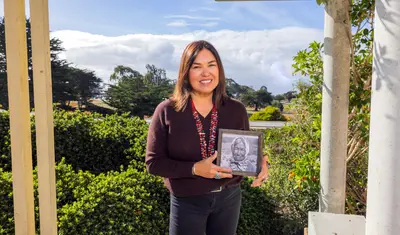
Rebecca Roanhorse-Nannie wants to support students and create community
By Sophia Huang McKenzie
They lived in traditional Navajo dwellings called “hogans” with dirt floors and no electricity or running water. They hauled water from a well for their daily needs. The bathroom was an outhouse.
“You made sure to go before bed, or you went to the outhouse in the middle of the night, guided by moonlight. We thought it was an adventure. We thought it was amazing. We loved it!”
Rebecca Roanhorse-Nannie, interim administrative services manager for Information Technology at Cal State Monterey Bay, has only happy childhood memories of visiting her Navajo family in Arizona. But at the recent grand opening of CSUMB’s new Native American Center, she felt mixed emotions. In particular, the remarks of Louise J. Miranda Ramirez, tribal chairwoman of the Ohlone/Costanoan Esselen Nation, struck a chord and brought tears to her eyes.
“I think there was a connection that I was missing before,” Roanhorse-Nannie said. “Chairwoman Ramirez expressed it so beautifully. You first have to acknowledge the trauma and what has been taken. Only then can you turn it into action and offer something back.”
Roanhorse-Nannie is the youngest of six children, three boys and three girls. Her father, Herman Roanhorse, is Diné, which means “The People” in the Navajo language. His clan is Tsi’naajinii, the “Black Streak Wood People.” He was born at Navajo Nation, the largest Native American reservation in the United States. Every summer when she was growing up, the family traveled there to visit relatives.
“We would drive straight through from California, long drives through the night. We always brought gifts to the Native children, and they would come running when they saw our family,” she said.
“The entire family lived there then. We would see wild horses running. There were lots of kids, lots of traditional food. My grandmother would make fry bread and mutton stew, the family would sit and talk in Navajo, and we just played and played!”
As an adult, Roanhorse-Nannie has come to understand that Navajo history is marked by hardship and displacement, as well as extraordinary resilience, determination and strength. During the Long Walk between 1863 and 1866, thousands died when the U.S. government forced the Navajo to leave their ancestral homeland and walk hundreds of miles in harsh winter conditions without adequate food, clothing and shelter. They were allowed to return following the Treaty of 1868 and have struggled to build lives there ever since.
Her father left his home on the reservation as a young boy, voluntarily seeking educational opportunities and a path out of poverty. He attended the federal government’s Intermountain Indian School in Utah, where he was forbidden to speak his native language. He eventually learned the welding trade, moved to San Jose, California, married and raised his children.
In later years, he reconnected with his Diné roots, sharing stories and cultural traditions with his grandchildren. Roanhorse-Nannie said she has made a heartfelt promise to her father that he will one day return home to the Navajo Nation for his final resting place.
Native American Heritage Month in November is especially meaningful to her this year because of the historic election of Crystalyne Curley as president of the Navajo Nation. She is the first woman to hold the position.
Roanhorse-Nannie plans to attend Curley’s inauguration in January 2027 with family, including her paternal aunt, Hannah Laura-Jeans, the family matriarch. Her aunt continues to preserve and share Diné traditions, language, songs, dances and cultural teachings with the younger generations.
“She remains deeply connected to our ancestral homeland and maintains her home on the reservation. Her dedication is a reminder that our culture is not simply something we remember from the past; it is something we continue to live, honor and pass forward,” Roanhorse-Nannie said.
At the Native American Center opening, she greeted students and pledged to host a meal with traditional Navajo foods for them in the future.
“I want to offer support to the students and to the center, to bring that sense of community. It was an honor to be here and to hear about the work that has been done, and the work that will continue,” she said.
“I value the opportunity to share my Diné heritage and contribute to a campus culture where our diverse histories, identities and experiences are recognized and celebrated.”