News Information
- Published
- November 17, 2026
- Department/College
- Office of Inclusive Excellence and Sustainability, University News
- News Type
- News Topics


Amanda Armstrong attributed the honor to a collective effort by everyone on campus.
By Mark Muckenfuss
No one talks trash like Amanda Armstrong.
As Cal State Monterey’s waste engagement and outreach coordinator in the Safety, Risk and Sustainability department, she is responsible for helping the campus meet its waste diversion goal.
Lately, however, she’s also been able to talk about how the campus is already an example of doing things right.
A sign now greets drivers on Divarty Street, commemorating CSUMB’s designation as a Clean California Community.
“I think it’s really special,” Armstrong said. “It really reflects the efforts of our entire campus community. It isn’t something that one individual can accomplish alone. It's everyone making choices and continuing to work on our larger goals.”
She said her office became aware of the designation through Monterey County being named a Clean California Community. The Caltrans-sponsored program is also affiliated with Keep California Beautiful and Keep America Beautiful. CSUMB is only the third university in the state to receive the designation, behind Sacramento State and UC Santa Cruz.
To be recognized, she said, CSUMB only needed to continue practices that were already in place.
“The 10 criteria we had to check off were things we’ve been working on for 10 years,” she said. “We realized we already met the criteria.
But, she emphasized, there is still work to do to make the campus even more environmentally friendly. That includes such things as diverting more material from CSUMB’s waste stream by channeling it to recycling and composting, planting more trees and getting more people involved in campus cleanups.
The campus has a goal of achieving a zero-waste designation by 2030. To do that, 90% of waste must be diverted from landfills through reduction, reuse, recycling and composting
“Ninety percent is actually higher than the state’s goal for diversion,” she said. “Right now we are at 35%.”
Armstrong said she spends much of her time speaking to groups in various university offices about how to sort their trash. Education, she said, is an important element in reaching the university’s goal, and so far she has met with 58% of CSUMB’s staff and faculty.
She also initiated a student volunteer program this year called Trash Talkers.
“The students volunteer time to make events more sustainable and help with waste sorting during events,” she said.
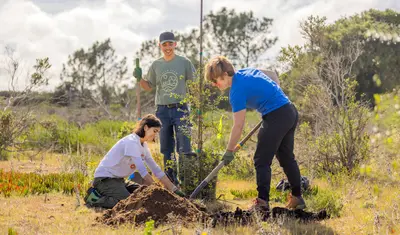
Tree planting and beautification were other key parts of meeting the criteria for the designation. Several years ago, CSUMB set a goal of planting 2,030 trees and plants by the end of this decade. The campus is more than halfway to that mark. Armstrong did not have a count of the number of plants that have been added to the landscape, but said 1,028 trees have been planted so far.
Armstrong said funding is a key part of meeting the tree-planting goal. Right now, she said, her department is seeking additional money to be able to carry out more such work.
She emphasized that both tree planting and keeping the campus clean require a team effort, with students, faculty and staff all chipping in by properly sorting waste, reducing their use of single-serving containers, helping with campus cleanups and other projects. She’s encouraged by what she sees.
“What I hope is that people see this recognition as something they helped make possible,” she said.