News Information
- Published
- October 20, 2026
- Department/College
- College of Health Sciences and Human Services, University News
- News Type
- News Topics


Otter Futures and a program to support more nursing students from underserved communities will both benefit from new federal grants.
By Mark Muckenfuss
Two federal grants totalling more than $5 million have been awarded to Cal State Monterey Bay in the last two weeks. Both are geared toward improving the workforce readiness of graduates, one through a curriculum-level approach that will impact all students, while the other targets the university’s growing nursing program.
The broader of the two, a five-year $3 million grant, comes from the Employment and Training Administration at the U.S. Department of Labor, acting on behalf of the Department of Education.
The money will support the Otter Futures program, a campus-wide initiative that is designed to impact not only academics but also co-curricular programs, student services and the construction of facilities. The program is designed to link campus activities and academics in a way that students can see how each of their experiences builds a foundation for their futures.
“It touches every element on campus,” said kinesiology Professor Maria Bellumori, who wrote the grant proposal. “Career Services, the Cooperative Learning Center, Institutional Research, and Alumni Relations will be partners in this project.
“The students will benefit greatly from this,” she added.
Cindy Juntunen, associate provost for research and dean of Graduate Studies, said the impact of the programmatic aspects will be felt quickly.
“We’ll see impacts pretty quickly,” she said. “That’s the exciting part of it.”
The most tangible element of the program, the construction of a $650,000 head house for CSUMB’s new greenhouse complex, will take more time.
“With the head house,” she said, “agriculture students can do a lot more hands-on experimentation, research and work-based learning.”
That grant opportunity coincided with the establishment of Otter Futures earlier this year at the suggestion of Andrew Lawson, provost and vice president for academic affairs. The grant was advertised a short time after. Juntunen encouraged Bellumori to apply, even though it was a tight deadline.
“It was a three-week turnaround time,” Bellumori said. “I lost a lot of sleep during that time. But it came together nicely.
“This work was going to continue regardless,” she added. “The funding just makes it easier.”
One of the major efforts will be to lift some of the load off career coaches by incorporating such things as resume and cover letter writing into the classroom.
This way, Bellumori said, “the career coaches don’t have to spend their time on the basic skills. They can have the higher-level conversations, such as, ‘How do we tweak your resume for this specific job?’ They can do more robust career coaching.”
Otter Futures will also promote “more internship opportunities for students,” she added. “In line with that, we want to hopefully have every student have two work-based experiences before they graduate, but at least one. That can include service learning.”
Juntunen said that currently, 22% of CSUMB students have had an internship by graduation. The goal is to raise that to 35% in the next five years. Additionally, the grant proposal includes a goal of raising the level of students finding post-graduation jobs in a field related to their majors from the current 41% to 50%.
"That's a tough one,” she said, ”especially in today’s market.”
But she’s confident the investment will pay off.
“This grant is very carefully trying to change the student experience by creating a system of faculty and staff support to provide work-based education,” she said. “It’s an opportunity to change the entire campus environment. I think it will make a big difference.”
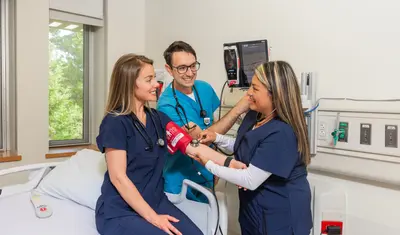
Alyssa Erikson, chair of CSUMB’s Montage Health Helen Baszucki School of Nursing, expects the $2.2 million her department is receiving over four years to also have a significant impact.
“This is definitely a huge award because federal funding is so competitive,” Erikson said.
Out of hundreds of applicants, the Department of Health and Human Services chose to support just 38 schools, she said.
“The grant will be used to develop a formal Otter Nurse Network,” she said. “It’s to increase the nursing workforce through recruiting and retaining students from educationally and economically disadvantaged backgrounds.”
Forty students, out of an approximate cohort of 100, will receive scholarships and stipends to help them stay in school.
“Students face a lot of barriers,” Erikson said. “Those often are financial barriers.”
In addition, all students in the program will receive additional mentoring and networking support, and grant funds will be used for faculty professional development.
With the grant, Erikson said, “We are expecting to increase by 10% our students from disadvantaged backgrounds to better reflect the community we serve.”